Uses
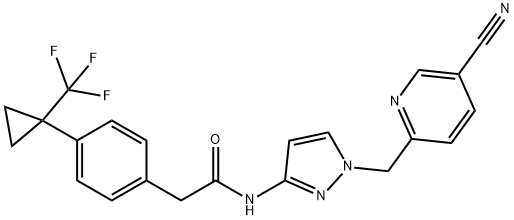
Apinocaltamide (ACT-709478) is a potent, selective, orally active, and brain penetrating T-type calcium channel blocker. ACT-709478 is used in the research of generalized epilepsies[1].
Definition
ChEBI: Apinocaltamide is a secondary carboxamide resulting from the formal condensation of the carboxy group of {4-[1-(trifluoromethyl)cyclopropyl]phenyl}acetic acid with the amino group of 6-[(3-amino-1H-pyrazol-1-yl)methyl]pyridine-3-carbonitrile. It is a selective, orally available T-type calcium channel blocker that is being studied as a potential new treatment in epilepsy. It has a role as an anticonvulsant and a T-type calcium channel blocker. It is a member of pyrazoles, a secondary carboxamide, a member of cyclopropanes, an organofluorine compound, a nitrile, a member of pyridines and a member of benzenes.
in vivo
Apinocaltamide (Compound 66b, 100, 300 mg/kg, p.o., measured 12 hours later) potently decreases the cumulative duration of absence-like seizures in mice[1].
| Animal Model: | Male juvenile DBA/2J mice (22-24 days old)[1] |
| Dosage: | 100, 300 mg/kg, 1 hour or 3 hours before exposure to the stimulus. |
| Administration: | P.O., for 12 hours |
| Result: | Decreased the cumulative duration of absence-like seizures over the next 12 h period by 93%. |
IC 50
Ca
v1.2: 2410 nM (IC
50); Ca
V3.1: 6.4 nM (IC
50); Ca
v3.2: 18 nM (IC
50); Ca
V3.3: 7.5 nM (IC
50)
References
[1] Bezenon O, et al. Discovery of a Potent, Selective T-type Calcium Channel Blocker as a Drug Candidate for the Treatment of Generalized Epilepsies. J Med Chem. 2017 Dec 14;60(23):9769-9789. DOI:
10.1021/acs.jmedchem.7b01236