Chemical Properties
white fine crystalline powder
Uses
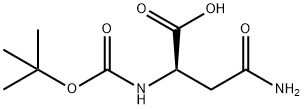
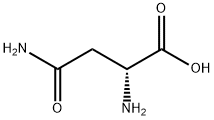
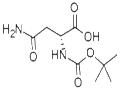
Nα-Boc-D-asparagine is an N-Boc-protected form of D-Asparagine (A788990). D-Asparagine is an isomer of L-Asparagine (A790005) and is used by bacteria (such as Saccharomyces cerevisiae) as a sole nitrogen source for replication. L-Asparagine is also a competitive inhibitor of staphylococcal L-asparaginase and is used as a reagent to synthesize peptide antibiotics.
Definition
ChEBI: Boc-D-asparagine is an asparagine derivative.
reaction suitability
reaction type: Boc solid-phase peptide synthesis
Synthesis
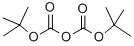
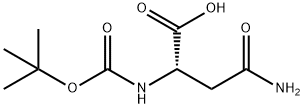
General procedure for the synthesis of BOC-L-asparagine from D-asparagine monohydrate and di-tert-butyl dicarbonate: in Example 75, 5-[5-fluoro-2-oxo-1,2-dihydro-indol-(3Z)-ylidene-methylene]-2,4-dimethyl-1H-pyrrole-3-carboxylic acid [(S)-1-(2-methoxy-ethyl)-2,5-dioxo-pyrrolidin- 3-yl]-amide ester (75a, 2.0 g, 15 mmol) and Na2CO3 (1.6 g, 15 mmol) were dissolved in a solvent mixture of H2O/1,4-dioxane (30 mL/30 mL). To this solution, di-tert-butyl dicarbonate (Boc)2O (3.96 g, 18.2 mmol) was added dropwise at room temperature. The reaction mixture was stirred overnight and subsequently 1,4-dioxane was removed by evaporation. The remaining aqueous solution was adjusted to pH=2 with 37% HCl. The precipitate precipitated was filtered, washed with water and dried to afford the target product 75b (2.97 g, 84% yield) as a white solid.
References
[1] Patent: WO2008/33562, 2008, A2. Location in patent: Page/Page column 86
[2] Patent: US2009/76005, 2009, A1. Location in patent: Page/Page column 44
[3] Journal of Medicinal Chemistry, 2013, vol. 56, # 7, p. 2936 - 2947
[4] Journal of the American Chemical Society, 2014, vol. 136, # 26, p. 9244 - 9247