Uses
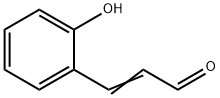
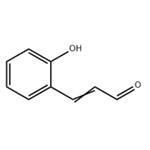
2-Hydroxycinnamaldehyde is a phenylpropanoid that can be isolated from the bark of Cinnamomum cassia. 2-Hydroxycinnamaldehyde inhibits Wnt/β-catenin, STAT3 signaling. 2-Hydroxycinnamaldehyde induces cell apoptosis 2-Hydroxycinnamaldehyde has antitumor and anti-inflammation activities[1][2][3].
Definition
ChEBI: (E)-3-(2-Hydroxyphenyl)-2-propenal is a member of cinnamaldehydes.
Synthesis
To a solution of 2-hydroxybenzaldehyde (10 g, 81.8 mmol) in THF (150 ml) was added (formylmethylene)triphenylphosphine (24.89 g, 81.8 mmol) at room temperature. The resulting reaction mixture was refluxed at 100 C for 20 hours. The reaction mixture was cooled to room temperature and extracted with water (200 ml) and ethyl acetate (3 x 150 ml). The combined organic phases were washed with water (150 ml), brine (150 ml), dried with sodium sulfate and concentrated in vacuum to give the desired crude product. The crude product was purified by column chromatography using normal phase silica gel. The desired product was eluted in a hexane solution of about 20-30% ethyl acetate. The product grade was evaporated to give 8.7 g (yield, 71.86%) of the desired compound as a yellow solid.
References
[1] Lee MA, et al. Antitumor activity of 2-hydroxycinnamaldehyde for human colon cancer cells through suppression of β-catenin signaling. J Nat Prod. 2013 Jul 26;76(7):1278-84. DOI:
10.1021/np400216m[2] Yoon YJ, et al. 2'-hydroxycinnamaldehyde inhibits cancer cell proliferation and tumor growth by targeting the pyruvate kinase M2. Cancer Lett. 2018 Oct 10;434:42-55. DOI:
10.1016/j.canlet.2018.07.015[3] Hao Let al. 2'-Hydroxycinnamaldehyde ameliorates imiquimod-induced psoriasiform inflammation by targeting PKM2-STAT3 signaling in mice. Exp Mol Med. 2021 May;53(5):875-884. DOI:
10.1038/s12276-021-00620-z