Application
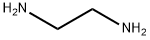
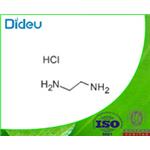
Ethylenediamine hydrochloride is widely used not only in the production of pesticides, pharmaceuticals, and chemical auxiliaries, but also has significant applications in the textile, paper, coating, and adhesive industries. Ethylenediamine hydrochloride crystals were synthesized in 2000, and their structure was characterized. [Image link: https://www.chemicalbook.com/NewsImg/2020-03-05/20203518124133863.png]
Synthesis
Preparation of 2-aminoethylammonium chloride (ethylenediamine hydrochloride): (1) firstly, 2740g of n-butylamine and 1489g of chloropropyltrimethoxysilane were added to the reaction kettle according to the molar ratio of n-butylamine to chloropropyltrimethoxysilane of 5:1, and then the temperature was increased slowly to (85~90)C while stirring and reacted for 8h under the reaction temperature, to obtain the reaction solution containing N-[3-(trimethoxysilyl)propyl n-butylamine], n-butylamine hydrochloride and an excess of n-butylamine in the reaction solution, and when the reaction was finished, 1923 g of n-butylamine in the reaction solution was distilled under micro-negative pressure; (2) then the temperature in the reaction kettle was controlled at 70 , and then 540 g of ethylenediamine was added to the reaction kettle according to the feeding ratio of ethylenediamine and n-butylamine hydrochloride generated in step (1) with a molar ratio of 1.2:1, and then it was stirred for 1 h, so that Ethylenediamine and n-butylamine hydrochloride to carry out a sufficient displacement reaction to generate ethylenediamine hydrochloride, and when the stirring was finished, the liquid was separated after holding and standing at a temperature of 65C for 6h, and 1,943g of the upper reaction solution containing N-[3-(trimethoxysilyl)propyl]n-butylamine, n-butylamine and ethylenediamine was obtained, as well as 865g of the lower reaction solution containing ethylenediamine hydrochloride.