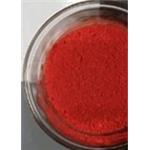
Description
As the mineral hematite, Iron oxide is the main source of iron for the steel industry. Iron oxide is easily attacked by acids. Iron(III) oxide is regularly called rust, and to some extent this label is useful, as rust shares several properties and has a comparable composition. To a chemist, though, rust is thought of as an ill-defined material, described as hydrated ferric oxide. Fe2O3 can be formed in various polymorphs.
Uses
Iron Oxide is a trace mineral used as a pigment and colorant. it is
used to color pet food.
Uses
iron oxide (iron oxide black, red, or yellow) is an inorganic compound frequently used to add color to cosmetics. It may have some slight sun screening ability. Iron oxide can vary in color from red to brown, black to orange or yellow, depending on the purity and amount of water added.
Definition
Pigments composed mainly of
ferric oxide (Fe2O3).
Industrial uses
Iron oxide is the fine red abrasive component of rouge. Like tripoli, rouge is blended with various soft binders into a cake form. It is used to polish high noble metal alloys such as yellow gold alloys.
Synthesis
Iron oxide nanoparticles are produced via co-precipitation using hydrated ferric chloride, deionized water, and ammonium hydroxide, or by hydrothermal oxidation of iron[2]. Green synthesis utilizes Clove and green coffee extracts to reduce metal ions, forming zero-valent iron that oxidizes into magnetite nanoparticles, which are subsequently calcined at 550 °C to obtain stable crystalline structures[1][3].
Solubility in organics
Iron(III) oxide is insoluble in water but dissolves readily in strong acid, for example, hydrochloric and sulfuric acids. It likewise dissolves well in solutions of chelating agents such as EDTA and oxalic acid. Heating iron(III) oxides with other metal oxides or carbonates yields materials known as ferrates (ferrate (III)).
References
[1]Mohamed, A., Atta, R. R., Kotp, A. A., El-Ela, F. I. A., El-Raheem, H. A., Farghali, A., Alkhalifah, D. H. M., Hozzein, W. N., & Mahmoud, R. (2023). Green synthesis and characterization of iron oxide nanoparticles for the removal of heavy metals (Cd2+ and Ni2+) from aqueous solutions with Antimicrobial Investigation. Scientific Reports, 13(1).
https://doi.org/10.1038/s41598-023-31704-7 [2]Ogbezode, J. E., Ezealigo, U. S., Bello, A., Anye, V. C., & Onwualu, A. P. (2023). A narrative review of the synthesis, characterization, and applications of iron oxide nanoparticles. Discover Nano, 18(1).
https://doi.org/10.1186/s11671-023-03898-2 [3]Suppiah, D. D., Julkapli, N. M., Sagadevan, S., & Johan, M. R. (2023). Eco-friendly green synthesis approach and evaluation of environmental and biological applications of iron oxide nanoparticles. Inorganic Chemistry Communications, 152, 110700.
https://doi.org/10.1016/j.inoche.2023.110700