
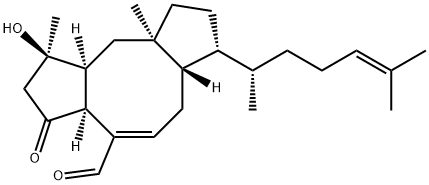
ophiobolin C
- Product Nameophiobolin C
- CAS19022-51-6
- CBNumberCB31317681
- MFC25H38O3
- MW386.57
- MDL NumberMFCD09752745
- MOL File19022-51-6.mol
- MSDS FileSDS
Chemical Properties
| storage temp. | Store at -20°C |
| solubility | DMF: soluble; DMSO: soluble; Ethanol: soluble; Methanol: soluble |
| form | A solid |
ophiobolin C Price
| Product number | Packaging | Price | Product description | Buy |
|---|---|---|---|---|
| Cayman Chemical 20186 | 1mg | $306 | Ophiobolin C ≥85% |
Buy |
| Cayman Chemical 20186 | 5mg | $1377 | Ophiobolin C ≥85% |
Buy |
| Usbiological O7024-02 | 1mg | $638 | Ophiobolin C (Zizzanin A) ~98% |
Buy |
| ApexBio Technology C4974 | 1mg | $461 | Ophiobolin C |
Buy |
| ApexBio Technology C4974 | 5mg | $1956 | Ophiobolin C |
Buy |
ophiobolin C Chemical Properties,Usage,Production
Description
Ophiobolin C is a sesterterpenoid fungal phytoxin produced by many species of the genus Bipolaris. It has been identified as an antagonist of chemokine receptor CCR5 binding (IC50 = 40 μM) to the envelope protein gp120 and to CD4, which is known to mediate HIV-1 viral entry into cells. Ophiobolin C is also reported to be cytotoxic to chronic lymphocytic leukemia cells (LC50 = 8 nM).Uses
Ophiobolin C is an inhibitor of human CCR5 binding to HIV-1 gp120.Uses
Ophiobolin C is a member of the ophiobolin class of phytotoxic metabolites produced by many species of the genus Bipolaris. Ophiobolin C inhibits human CCR5 binding to the envelope protein gp120 and CD4 that mediates HIV-1 entry into cells. Blockade of this binding was considered by scientists at Merck as a potential new mode of action for the treatment of HIV-1 infection.Definition
ChEBI: Ophiobolin C is a sesterterpenoid that is ophiobolane with a hydroxy group at position 3, oxo group at positions 5, formyl group at position 7, and double bonds at positions 7-8 and 19-20. It has a role as an antineoplastic agent, an apoptosis inducer, an Aspergillus metabolite, a chemokine receptor 5 antagonist, a nematicide and a fungal metabolite. It is a cyclic ketone, an enal, a sesterterpenoid, a tertiary alcohol, a carbotricyclic compound and an olefinic compound. It derives from a hydride of an ophiobolane.IC 50
CCR5; HIV-1References
[1] HIRANTHI JAYASURIYA. Isolation and Structure of Antagonists of Chemokine Receptor (CCR5)[J]. Journal of Natural Products , 2004, 67 6: 1036-1038. DOI: 10.1021/np049974l[2] TANJA THORSKOV BLADT. Bio-activity and dereplication-based discovery of ophiobolins and other fungal secondary metabolites targeting leukemia cells.[J]. Molecules, 2013, 18 12: 14629-14650. DOI: 10.3390/molecules181214629
Preparation Products And Raw materials
ophiobolin C Supplier
Global(35)Suppliers
| Supplier | Tel | Country | ProdList | Advantage | |
|---|---|---|---|---|---|
| 86-(0)29-85992781 17792393971 |
info@lynnchem.com | China | 4578 | 58 | |
| 44-20819178-90 02081917890 |
info@novachemistry.com | United Kingdom | 4372 | 58 | |
| +86-400-002-6226 | sales@rrkchem.com | China | 57336 | 58 | |
| 16314854226; +8616314854226 |
inquiry@bocsci.com | United States | 19852 | 58 | |
| +1-781-999-5354; +1-00000000000 |
marketing@targetmol.com | United States | 32431 | 58 | |
| 18818260767 | sales@chemegen.com | China | 11123 | 58 | |
| 400-820-6829 | sales@mitachieve.com | China | 8857 | 58 | |
| 0571-89903022 18679456698 |
zilong@hizyme.com | China | 8001 | 58 | |
| 021-58432009 400-005-6266 |
marketing@energy-chemical.com | China | 44871 | 58 | |
| 4008200310 15002144251 |
marketing@tsbiochem.com | China | 24951 | 58 |
View Latest Prices from ophiobolin C manufacturers

19022-51-6, ophiobolin CRelated Search
PROMPT×
PROMPT
The WhatsApp is temporarily not supported in mainland China
The WhatsApp is temporarily not supported in mainland China
Cancel
Determine