Uses
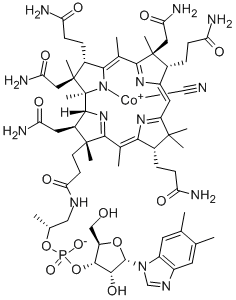
Vitamin B12 (cobalamin) is an essential micronutrient that acts as a cofactor for methionine synthase and methylmalonyl-CoA mutase, supporting DNA methylation, nucleotide synthesis, and genome stability. Its cyanocobalamin form serves as a stable active substance in pharmaceuticals and dietary supplements[1-2].
Definition
ChEBI: A cobalamin in which the central cobalt atom has an oxidation state of +3.
Synthesis
In 1960, the research group of the biochemist Konrad Bernhauer in Stuttgart had reconstituted vitamin B12 from one of its naturally occurring derivatives, cobyric acid, by stepwise construction of the vitamin's nucleotide loop. Therefore, cobyric acid was chosen as the target molecule for a total synthesis of vitamin B12 (cobalamin).

References
[1]
Halczuk, K., Kaźmierczak-Barańska, J., Karwowski, B. T., Karmańska, A., Cieślak, M. (2023). Vitamin B12—Multifaceted In Vivo Functions and In Vitro Applications. Nutrients, 15(12), 2734.
https://doi.org/10.3390/nu15122734 [2]
Rizzo, G., Laganà, A. S. (2020). A review of vitamin B12. Molecular Nutrition, 105–129.
https://doi.org/10.1016/b978-0-12-811907-5.00005-1