Description
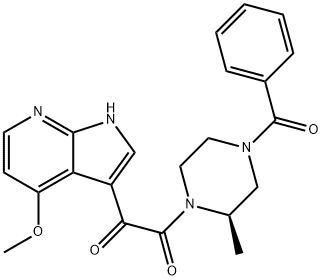
BMS-806 is a small molecule that inhibits the first step of HIV-1 infection by blocking the binding of host cell CD4 with viral gp120 protein. It binds the exterior envelope glycoprotein gp120 (K
d= 21.1 nM; K
i = 24.9 nM), blocking the conformational change that occurs with CD4 binding and preventing fusion of the viral and target cell membranes. BMS-806 is specific to HIV-1 irrespective of chemokine receptor preference, with no activity against HIV-2, SIV, or a panel of additional viruses.
in vivo
In toxicology studies, BMS-378806 is well tolerated in rats at doses of 100 mg/kg/day for 2 weeks and in dogs at doses of 90 mg/kg for 10 days. The dose-proportional increases in the AUC and Cmax are observed between doses of 5 and 25 mpk, when BMS-378806 is administered either in the solution or suspension formulation. In all three species, plasma levels of drug exceeded the concentrations required to half-maximally inhibit virus replication in vitro. The volume of distribution of BMS-378806 ranges from 0.4 to 0.6 L/kg, indicative of partitioning beyond plasma; however, examination of brain levels in the rat reveals minimal CNS penetration[1].
References
[1] wang t1, zhang z, wallace ob, deshpande m, fang h, yang z, zadjura lm, tweedie dl, huang s, zhao f, ranadive s, robinson bs, gong yf, ricarrdi k, spicer tp, deminie c, rose r, wang hg, blair ws, shi py, lin pf, colonno rj, meanwell na. discovery of 4-benzoyl-1-[(4-methoxy-1h- pyrrolo[2,3-b]pyridin-3-yl)oxoacetyl]-2- (r)-methylpiperazine (bms-378806): a novel hiv-1 attachment inhibitor that interferes with cd4-gp120 interactions. j med chem. 2003 sep 25;46(20):4236-9.