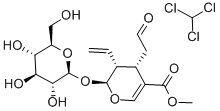
Description
Secologanin is a monoterpene that has been found in
V. rosea and is an intermediate in the synthesis of monoterpene indole alkaloids from geraniol. It is a metabolite of loganin formed by the cytochrome P450 (CYP) isoform CYP72A1, also known as secologanin synthase.
Uses
(-)-Secologanin is an iridoid glycoside found in Hydrangeaceae used in anti-inflammatory.
Definition
ChEBI: (-)-secologanin is an iridoid monoterpenoid that is acetaldehyde in which on of the hydrogens of the methyl group has been replaced by a 2-(beta-D-glucopyranosyloxy)-3,4-dihydro-2H-pyran-4-yl group which is substituted at positions 3 and 5 by a vinyl and a methoxycarbonyl group, respectively (the 2S,3R,4S stereoisomer). It has a role as a plant metabolite. It is a beta-D-glucoside, a methyl ester, an aldehyde, an enoate ester, a secoiridoid glycoside and a member of pyrans.
References
[1] A. BATTERSBY P P A R Burnett. Alkaloid biosynthesis. Part XIV. Secologanin: its conversion into ipecoside and its role as biological precursor of the indole alkaloids[J]. Journal of The Chemical Society C: Organic, 1969, 61 1: 1187-1192. DOI:
10.1039/j39690001187[2] KAREL MIETTINEN. The seco-iridoid pathway from Catharanthus roseus.[J]. ACS Combinatorial Science, 2014: 3606. DOI:
10.1038/ncomms4606[3] S IRMLER. Indole alkaloid biosynthesis in Catharanthus roseus: new enzyme activities and identification of cytochrome P450 CYP72A1 as secologanin synthase.[J]. The Plant Journal, 2000, 24 6: 797-804. DOI:
10.1046/j.1365-313x.2000.00922.x