Chemical Properties
White to beige powder
Uses
Pharmacological activity studied in regard to:
- Interactions of carrier ligands of antidiabetic metal complexes with human serum albumin
- Ability to chelate metalloenzyme inhibitors
- Interactions of insulin-mimetic zinc(II) complexes with cell constituents
Reactant for:
- Synthesis of inhibitors of human 11β -hydroxysteroid dehydrogenase type 1
- Lewis base organocatalysts for stereoselective hydrosilylation reactions
Biological studies of insulin-enhancing complexes
General Description
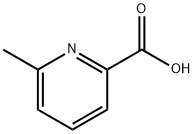
6-Methylpyridine-2-carboxylic acid (2-carboxy-6-methylpyridine, 6-methylpicolinic acid) is a heterocyclic building block.
Synthesis
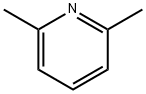
Step 1: 2,6-dimethylpyridine (10.71 g, 0.1 mol) was dissolved in 500 mL of deionized water, stirred and heated to 60 °C. Subsequently, potassium permanganate (KMnO4, 23.7 g, 0.15 mol) was added in ten portions, with an interval of 30 min between each addition. The temperature was strictly controlled at about 60°C during the reaction, which lasted for 5 h and then stopped. Immediately after completion of the reaction, the insoluble impurities were removed by filtration. The filtrate was adjusted to pH=5 and then extracted with ethyl acetate. The organic phase was collected, concentrated under reduced pressure and finally recrystallized from ethanol to obtain 6-methyl-2-pyridinecarboxylic acid (10.3 g, 75% yield). In this step, the effects of different reaction conditions (e.g., equivalents of KMnO4 of 1, 1.5 and 2, aqueous potassium permanganate solution of different pH, temperature and molar ratio) on the reaction were investigated by orthogonal tests, and the optimal reaction conditions were determined to be neutral aqueous potassium permanganate solution with a dosage of 1.5 equivalents of KMnO4.
References
[1] Patent: CN105294552, 2016, A. Location in patent: Paragraph 0047; 0048; 0049; 0050
[2] Chemische Berichte, 1900, vol. 33, p. 1226
[3] Chemische Berichte, 1900, vol. 33, p. 1081
[4] Chemische Berichte, 1900, vol. 33, p. 1230
[5] Journal of Organic Chemistry, 1949, vol. 14, p. 14,17