Synthesis
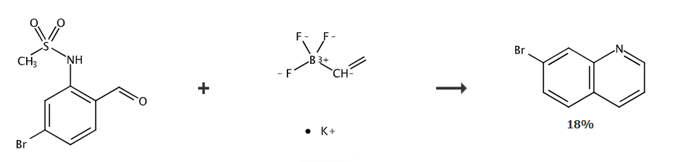
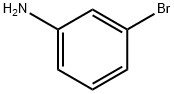
A solid alkenyl trifluoroborate ester (1 mmol), the corresponding carbonyl compound (1 mmol), and a stir bar were sealed in a 10 mL glass vial, which was then rinsed with dry nitrogen. 2.5 mL of anhydrous solvent (acetonitrile or toluene) was added, followed by 0.28 mL (203 mg, 2 mmol) of triethylamine, and the resulting suspension was stirred at room temperature for 5 minutes. Trichlorotrimethylsilane (TMSCl; 0.26 mL, 223 mg, 2.05 mmol) was then added in three portions. The mixture was stirred at 80 °C for 18 h, cooled, and diluted with 30 mL of ethyl acetate and 20 mL of water. The layers were separated, and the aqueous layer was extracted with 3 × 20 mL of ethyl acetate.
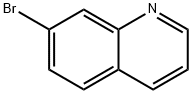
The combined organic layers were dried over Na₂SO₄, filtered, and evaporated. The product was separated by silica gel column chromatography (elution-ethyl acetate-hexane) and crystallized from diethyl ether pentane to give 7-bromoquinoline.
Uses
7-Bromoquinoline is an organic intermediate that can be used to prepare 1,4-dihydroquinoline heterocyclic compounds. 1,4-Dihydroquinoline heterocyclic compounds are not only a very important class of organic synthesis intermediates, but also widely used in various drugs because of their bactericidal, anti-inflammatory, anti-tumor and other biopharmacological activities.