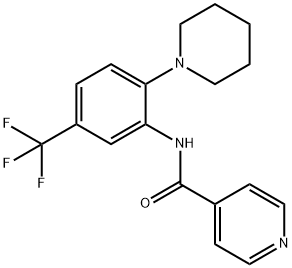
Description
Serine/arginine-rich protein kinase 1 (SRPK1) targets proteins that contain multiple serine/arginine (SR) dipeptides, including SR-
rich splicing factor 1, SRSF1. SRPIN340 is an isonicotinamide compound that inhibits SRPK1 (K
i = 0.89 μM). It is about 10-
fold less effective against SRPK2 and does not inhibit the related SRPKs, Clk1 and Clk4. SRPIN340 suppresses the propagation of Sindbis virus in Vero cells and the replication of hepatitis C virus in Huh7/Rep-
Feo-
2a cells. By blocking SRPK1-
mediated phosphorylation of SRSF1, SRPIN340 modulates alternative splicing of VEGF, reducing neovascularization both in cells and in animals.
Uses
SRPIN340 is a SRPK1 kinase inhibitor, which shows potential novel targeted therapeutic strategy in prostate cancer.
Synthesis
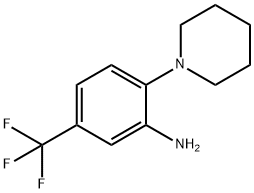
The general procedure for the synthesis of N-(2-(1-piperidinyl)-5-(trifluoromethyl)phenyl)isonicotinamide from 2-piperidin-1-yl-5-(trifluoromethyl)aniline and isocyanidinium chloride is as follows: isonicotinic acid chloride hydrochloride (6.48 g, 36.4 mmol, commercially available) and triethylamine (5.57 ml, 54.6 mmol) are sequentially added at 0°C to the 2-(1-piperidinyl)-5-(trifluoromethyl)aniline (4.45 g, 18.2 mmol, prepared as described in Reference Examples 1-2B) to a solution of methylene chloride (10 ml). The reaction mixture was stirred for 30 minutes. Subsequently, water was added to the mixture and extracted three times with ethyl acetate. The organic layers were combined, washed with saturated sodium chloride solution, dried over anhydrous sodium sulfate, filtered and concentrated under reduced pressure. The residue was purified by silica gel column chromatography (200 g silica gel, eluent ratio hexane/ethyl acetate = 1/1) and recrystallized. The final N-[2-(1-piperidinyl)-5-(trifluoromethyl)phenyl]isonicotinamide (SRPIN-1, GIF-0340) (5.49 g, 86.3% yield) was obtained as a colorless solid.
Background
Serine/arginine-rich protein-specific kinases 1 and 2 phosphorylate and regulate serine/arginine-rich proteins that bind and regulate mRNA splicing, playing an important role in post-transcriptional regulation. The small-molecule SRPIN340 is an SRPK inhibitor that is highly selective for SRPK1 and SRPK2. SRPK dysregulation can alter SR protein activity and promote expression of splicing isoforms, leading to increased viral infection or tumorigenic processes. Inhibition of SRPK1 and SRPK2 by SRPIN340 reduces SRp75 protein phosphorylation, leading to suppressed Sindbis virus propagation and reduced HIV production. Dose-dependent suppression of hepatitis C virus replication by the inhibitor SRPIN340 has been seen in vitro. SRPIN340 treatment of leukemia cells triggered early and late events of apoptosis, and reduced myeloid and lymphoid leukemia cell viability. Suppression of VEGF by SRPIN340 inhibited choroidal neovascularization formation in a mouse model, suggesting a possible role for SRPIN340 in treating neovascular age-related macular degeneration.
References
[1] TAKESHI FUKUHARA. Utilization of host SR protein kinases and RNA-splicing machinery during viral replication.[J]. Proceedings of the National Academy of Sciences of the United States of America, 2006: 11329-11333. DOI:
10.1073/pnas.0604616103[2] MELISSA V R GAMMONS. SRPK1 inhibition modulates VEGF splicing to reduce pathological neovascularization in a rat model of retinopathy of prematurity.[J]. ACS Applied Materials & Interfaces, 2013: 5797-5806. DOI:
10.1167/iovs.13-11634[3] M V GAMMONS. Targeting SRPK1 to control VEGF-mediated tumour angiogenesis in metastatic melanoma[J]. British Journal of Cancer, 2014, 111 3: 477-485. DOI:
10.1038/bjc.2014.342