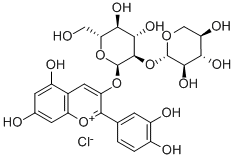
Chemical Properties
It is soluble in organic solvents such as methanol, ethanol, and DMSO, and is derived from cornflower.
Synthesis
To 10 kg of collected petals, 20 L of a solution in which acetic acid and methanol were mixed in a 1 to 1 ratio (50% acetic acid - methanol) was added directly and the anthocyanin dye was extracted at 20 to 25C. The extract was filtered through cotton plugs and the solvent was distilled under reduced pressure using a rotary evaporator. The extraction residue was dissolved in 5% aqueous acetic acid and subjected to open column chromatography. The conditions for open column chromatography were: stationary phase, MCI gel CHP-20P, Sephadex LH-20. solutions A to B using Chromatorex ODS using 5% acetic acid aqueous solution as solution A, 5% acetic acid-methanol as solution B as mobile phase, MCI gel (hereinafter referred to as MCI column) - Sephadex LH-20 column. ODS column was of the order of 10%. In addition, Sephadex LH-20 was used as the stationary phase, 5% aqueous acetic acid as Solution A, and 5% acetic acid - acetone as Solution C. Chromatography was performed by increasing the content of Solution A by 2% from Solution C. The chromatographic method was performed using a Sephadex LH-20 column. Finally, a Sephadex LH-20 column and an ODS column were used with 5% aqueous acetic acid as Solution A and 5% acetic acid - methanol as Solution B as the mobile phase, and the content of Solution B was increased by 5% each. By repeating these open column chromatographies, a series of anthocyanin analogs including anthocyanin-3-sambubioside chloride were obtained.