Uses
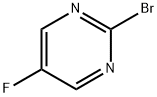
2-Bromo-5-fluoropyrimidine is an important organic synthetic building block. Its structure contains the bifunctional halogen atoms fluorine and bromine, which confer excellent reactivity on the compound. In the synthesis of JAK2 kinase inhibitors, it serves as a substrate for optimising the cyanation reaction, increasing the solution yield to 90 per cent. It can also be used as an aromatic nucleophilic substituent in the preparation of TEAD inhibitors [2–3].
Hazard
2-Bromo-5-fluoropyrimidine is irritating to human health. Exposure may cause respiratory tract irritation, skin irritation and severe eye irritation. It is prone to causing acute toxicity when inhaled or ingested.
Synthesis
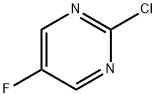
Step A: 2-chloro-5-fluoropyrimidine (2 mL, 22.18 mmol) was dissolved in propionitrile (20 mL) and bromotrimethylsilane (6 mL) was added. The reaction mixture was transferred to a sealed vial and heated at 150 °C for 1 hour. Upon completion of the reaction, the mixture was allowed to cool to room temperature and subsequently concentrated under reduced pressure. The concentrated residue was partitioned between ethyl acetate (EtOAc) and saturated aqueous sodium bicarbonate (NaHCO3). The organic phase was separated, dried over anhydrous sodium sulfate and concentrated again under reduced pressure. The resulting residue was dissolved in hexane and cooled overnight at -30 °C to precipitate a solid. The solid was collected by filtration to afford the target product 2-bromo-5-fluoropyrimidine (2.03 g, 51% yield). The structure of the product was confirmed by 1H NMR (300 MHz, CDCl3): δ 8.49 (s, 2H).
References
[1] Patent: US2012/53174, 2012, A1. Location in patent: Page/Page column 44
[2] Frodsham, L., Golden*, M., Hard, S. (2013). Use of ω-Transaminase Enzyme Chemistry in the Synthesis of a JAK2 Kinase Inhibitor.
Organic Process Research & Development,
17 9, 1123–1130.
https://doi.org/10.1021/op400133d[3] Lu, W., Fan, M., Ji, W. (2023). Structure-Based Design of Y-Shaped Covalent TEAD Inhibitors.
Journal of Medicinal Chemistry,
66 7, 4617–4632.
https://doi.org/10.1021/acs.jmedchem.2c01548