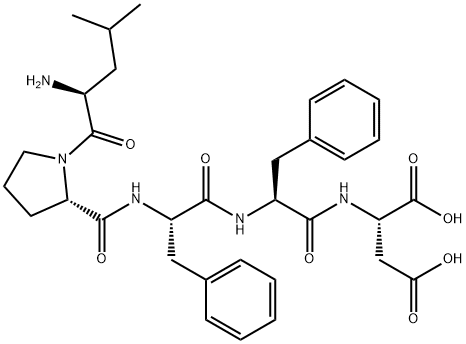
Uses
β-Sheet Breaker Peptide iAβ5 is an effective brain amyloid-β (Abeta) degrader. Abeta deposits are associated with Alzheimer's disease (AD), and the related toxicity arises from its β-sheet conformation and aggregation. β-Sheet Breaker Peptide iAβ5 can repeatedly induce the degradation of fibrillary amyloid deposits in vivo. Therefore, β-Sheet Breaker Peptide iAβ5 can prevent and/or reverse neuronal contraction caused by Abeta and reduce the range of interleukin IL-1beta positive microglial-like cells around Abeta deposits. β-Sheet Breaker Peptide iAβ5 can reduce the size and/or number of brain amyloid plaques in AD. β-Sheet Breaker Peptide iAβ5 is labeled with a hydrophobic benzyl alcohol (HBA) tag and shows a bright blue color under acidic conditions, which can be used for quantitative determination.
in vivo
β-Sheet Breaker Peptide iAβ5 (100 nmol/rat; Intra-amygdala injection; 7 days) coinjected with Aβ1-42 (5 nmol) into in the rat amygdala, blocks Aβ1-42 neurotoxicity in tissue culture, and amyloid fibril formation in the rat model[1].
β-Sheet Breaker Peptide iAβ5 (100 nmol/rat, 200 nmol/rat; Intra-amygdaloid injection; 7 days) followed by Aβ1-42 (5 nmol), induces disassembly of pre-existing Aβ fibrils in vivo, and leads to a reversal or prevention of Aβ-induced histopathological changes in rat model[2].
References
[1] Soto C, et al. Beta-sheet breaker peptides inhibit fibrillogenesis in a rat brain model of amyloidosis: implications for Alzheimer's therapy. Nat Med. 1998 Jul;4(7):822-6. DOI:
10.1038/nm0798-822[2] Sigurdsson EM, et al. In vivo reversal of amyloid-beta lesions in rat brain. J Neuropathol Exp Neurol. 2000 Jan;59(1):11-7. DOI:
10.1093/jnen/59.1.11[3] Okada Y, et al. Acid-Triggered Colorimetric Hydrophobic Benzyl Alcohols for Soluble Tag-Assisted Liquid-Phase Synthesis. Org Lett. 2015 Sep 4;17(17):4264-7. DOI:
10.1021/acs.orglett.5b02057