Application
Reactant involved in Suzuki cross coupling reactions
Reactant involved in the synthesis of biologically active molecules including:
Novel modulators of survival motor neuron protein for treatment of spinal muscular atrophy
Amino-trimethoxyphenyl-aryl thiazoles for use as microtubule inhibitors and antitumor agents
Bicyclic hydroxyphenyl methanone derivatives for use as hydroxysteroid dehydrogenase inhibitors
Dual immunosuppressive and anti-inflammatory agents
Antiproliferatives via Suzuki cross-coupling / amination reactions
Synthesis
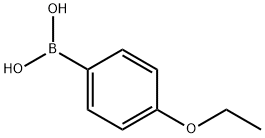
A hexane solution of butyllithium (30 mL, 1.58 M, 47 mmol) was added dropwise to a THF solution (50 mL) of 2-bromo-,-trifluorotoluene (9.79 g, 43.5 mmol) at -78 C. The aryllithium was then transferred to a THF solution of B(OEt)3 (30 mL, 176 mmol) by cannulae. After stirring at this temperature for 3 hours, the resulting aryl lithium was transferred via cannula to a THF solution (100 mL) of triethyl borate (B(OEt)3, 30 mL, 176 mmol) (aryl lithium may be unstable at higher temperatures. We recommend making the transfer as soon as possible). Warm the reaction mixture to room temperature and stir overnight. Hydrochloric acid (2M, 80 mL) was added and the mixture was extracted with ethyl acetate. The combined organic layers were dried with anhydrous sodium sulfate and then evaporated under vacuum. The desired boric acid was dissolved in hot toluene and separated from the toluene-insoluble residue. The combined toluene solutions were evaporated and the remaining solid was recrystallized from toluene to give 4-ethoxyphenylboronic acid in 6.02 g, 73% yield. Yield 16%.