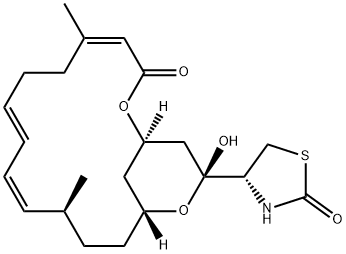
Description
Actin disruption is used to study cell functions
in vitro (
e.g., migration, endocytosis) and
in vivo (
e.g., tumor cell invasion). Latrunculin A is a bioactive 2-
thiazolidinone macrolide derived from sponges that sequesters G-
actin and prevents F-
actin assembly. It binds monomeric actin with 1:1 stoichiometry and can be used to block actin polymerization both
in vitro (K
d = 0.2 μM) and in cells (0.5 μM, 30 min).{ Latrunculin A (1-
10 μM) causes depolymerization of tumor cell cytoskeleton within ten minutes. Overnight treatment of cells with latrunculin A (10 μM) strongly suppresses actin synthesis. Prolonged cell treatment blocks dexamethasone-
induced changes in actin cytoskeleton with no effect on cell viability.
Uses
Latrunculin A, Latrunculia magnifica is a stabilizer of monomeric G-actin and polymerization inhibitor.
Uses
Latrunculin A has been used as medium supplementation for A549 cells to determine the internalization mechanism of CAV9 in A549 human lung carcinoma cells.
Definition
ChEBI: A bicyclic macrolide natural product consisting of a 16-membered bicyclic lactone attached to the rare 2-thiazolidinone moiety. It is obtained from the Red Sea sponge Latrunculia magnifica and from the Fiji Islands sponge Cacospongia myc
fijiensis. Latrunculin A inhibits actin polymerisation, microfilament organsation and microfilament-mediated processes.
General Description
Latrunculin A, a toxin extracted from the red sea sponge
Latrunculia magnifica. It participates
in vitro in the morphological alteration of the polymerization of pure actin. It forms a complex by binding with the nucleotide cleft of actin for actin filaments elongation.
Biochem/physiol Actions
Latrunculin A inhibits actin polymerization by a different mechanism than cytochalasins. Latrunculin A disrupts microfilament-mediated processes.
References
[1] MARTINE COUÉ . Inhibition of actin polymerization by latrunculin A[J]. FEBS Letters, 1987, 213 2: Pages 316-318. DOI:
10.1016/0014-5793(87)81513-2[2] ILAN SPECTOR. Latrunculins—novel marine macrolides that disrupt microfilament organization and affect cell growth: I. Comparison with cytochalasin D[J]. Cytoskeleton, 1989, 13 3: 127-144. DOI:
10.1002/cm.970130302[3] JUSHUO WANG Joseph W S Jean M Sanger. Differential effects of latrunculin-A on myofibrils in cultures of skeletal muscle cells: Insights into mechanisms of myofibrillogenesis[J]. Cytoskeleton, 2005, 62 1: 35-47. DOI:
10.1002/cm.20083[4] FULVIO REGGIORI. The actin cytoskeleton is required for selective types of autophagy, but not nonspecific autophagy, in the yeast Saccharomyces cerevisiae.[J]. Molecular Biology of the Cell, 2005, 16 12: 5843-5856. DOI:
10.1091/mbc.e05-07-0629[5] FARZAD ASADI Jim K Dorothy Michalski. A Genetic Screen for Fission Yeast Gene Deletion Mutants Exhibiting Hypersensitivity to Latrunculin A.[J]. G3 (Bethesda, Md.), 2016: 3399-3408. DOI:
10.1534/g3.116.032664