Synthesis
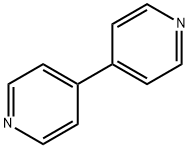
In a dry reaction flask, 4-bromopyridine (1.0 mmol), palladium acetate (5.61 mg, 0.025 mmol), indium (57.4 mg, 0.5 mmol), and lithium chloride (63.5 mg, 1.5 mmol) were dissolved in dry N,N-dimethylformamide (2 mL), and the mixture was reacted at 100 °C for 2.5 h under nitrogen protection. After the reaction was complete, the reaction mixture was quenched with saturated sodium bicarbonate aqueous solution, and the aqueous layer was extracted three times with ethyl acetate (3 × 20 mL). The organic layer was separated and washed with 20 mL of water and 20 mL of brine, respectively. The organic phase was dried with anhydrous magnesium sulfate, filtered to remove the drying agent, and the resulting filtrate was concentrated under reduced pressure. The residue was purified by silica gel column chromatography (ethyl acetate-n-hexane = 1:2) to obtain the target molecule 4,4'-bipyridine.
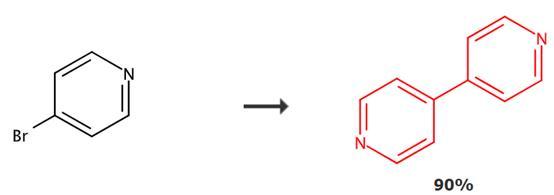
Figure 4,4'-bipyridine
Chemical Properties
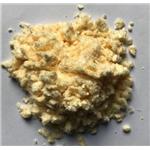
off-white to tan powder
Uses
4,4'-Bipyridine is used in transition-metal complex catalyst chemistry for uniform polymerization, in luminescence chemistry and in spectrophotometric analysis. It plays an important role as a photosensitizer and luminescent material. It is also used as a precursor to paraquat viz. N,N'-dimethyl-4,4'-bipyridinium.
Definition
ChEBI: A bipyridine in which the two pyridine moieties are linked by a bond between positions C-4 and C-4'.
General Description
4,4′-Dipyridyl (BPY) is an organic linker mainly used in the preparation of coordination polymers. It is a pyridine derivative in which pyridyl groups can rotate along the carbon-carbon structure. It can be used as a catalyst for photoelectrochemical reduction.
Safety Profile
Poison by ingestion. When heatedto decomposition it emits toxic vapors of NOx.
Purification Methods
It crystallises from water, *benzene/pet ether, ethyl acetate and sublimes in vacuo at 70o. Also purify it by dissolving in 0.1M H2SO4 and twice precipitating by addition of 1M NaOH to pH 8. Then recrystallise it from EtOH. For the dihydrochloride see Viologen below. [Collman et al. J Am Chem Soc 109 4606 1987, Beilstein 23 H 800, 23 III/IV 1371, 23/8 V 28.]