Uses
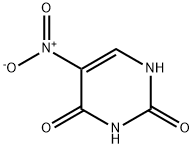
5-Nitrouracil is a compound useful in organic synthesis.
Chemical Properties
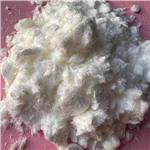
Off-White Solid
Uses
5-Nitrouracil (cas# 611-08-5) is a compound useful in organic synthesis.
Definition
ChEBI: 5-nitrouracil is a C-nitro compound consisting of uracil having a nitro group at the 5-position. It is functionally related to a uracil.
Synthesis
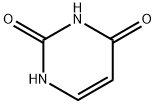
The general procedure for the synthesis of 5-nitropyrimidine-2,4(1H,3H)-dione from pyrimidine-2,4(1H,3H)-dione: Nitric acid solution (5.34 mL, 120 mmol, 70% solution) was added drop-wise to concentrated sulfuric acid (19.7 mL, 360 mmol, 98% solution) under the condition of the temperature not exceeding 50 ℃. Subsequently, pyrimidine-2,4(1H,3H)-dione (7.204 g, 60 mmol) was added to the stirred mixed acid solution in batches while controlling the reaction temperature not to exceed 50°C. The reaction mixture was heated to 55 °C and maintained for 3 h, after which it was cooled below room temperature and the reaction was quenched with ice water (38 mL). The resulting white precipitate was collected by filtration, washed with a small amount of ice water and dried under reduced pressure at 55 °C to afford 5-nitropyrimidine-2,4(1H,3H)-dione (8.658 g, 55.11 mmol, 92% yield) as a white solid. Product properties: decomposition temperature >288°C; thin layer chromatography Rf value 0.00 (unfolding agent ratio 1:10 ethyl acetate/hexane); IR spectrum (ZnSe pool, solid) vmax: 3142-2811 cm^-1 (medium, broad, OH/NH/CH), 1732 cm^-1 (strong, C=O), 1677 and 1624 cm^-1 (strong. NO2), 1417 cm^-1 (medium, CH), 1356 cm^-1 (medium, NO2), 1318 cm^-1 (strong, aromatic R2NH/R3N), 1234 cm^-1 (strong, -OH), 975 and 832 cm^-1 (weak, aromatic ring bending); 1H NMR (500 MHz, d6-DMSO): δ 8.84 ( 1H, single peak, 6-CH) ppm; 13C NMR (125 MHz, d6-DMSO): δ 155.5 (4-C=O), 149.8 (6-CH), 147.9 (2-C=O), 125.1 (5-CNO2) ppm.
Purification Methods
The uracil recrystallises in prisms from boiling H2O as the monohydrate and loses H2O on drying in vacuo. [UV: Brown J Chem Soc 3647 1959, Brown J Appl Chem 2 239 1952, Johnson J Am Chem Soc 63 263 1941, Beilstein 24 I 313, 24 II 171, 24 III/IV 1236.]
References
[1] European Journal of Medicinal Chemistry, 2015, vol. 95, p. 29 - 34
[2] American Chemical Journal, 1905, vol. 33, p. 443
[3] American Chemical Journal, 1908, vol. 40, p. 31
[4] Journal of Biological Chemistry, 1908, vol. 4, p. 410
[5] Journal of the American Chemical Society, 1919, vol. 41, p. 786