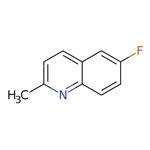
Chemical Properties
brown powder or granules
Uses
Quinoline derivative as a highly potent thrombin receptor antagonist
Uses
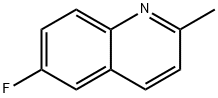
Metal-free transfer hydrogenation of 6-fluoro-2-methylquinoline by employing several chiral Brnsted acid catalysts was carried out in combination with dihydropyridines as the hydride source in asymmetric metal-free synthesis of fluoroquinolones by organocatalytic hydrogenation. Hydrogenation product of 6-fluoro-2-methylquinoline is the key intermediate of the antibacterial agent.
Synthesis
General procedure for the synthesis of 6-fluoro-1,2,3,4-tetrahydro-2-methylquinoline from 6-fluoro-1,2,3,4-tetrahydro-2-methylquinoline: 6-fluoro-1,2,3,4-tetrahydro-2-methylquinoline (0.50 mmol), FeCl2 (1.9 mg, 1.5 × 10⁻² mmol), DMSO (31.2 mg, 0.4 mmol) and p-xylene (1 mL). The reaction mixture was stirred using a balloon at 110 °C and oxygen atmosphere and the progress of the reaction was monitored by TLC. Upon completion of the reaction, the mixture was cooled to room temperature and purified by fast chromatography (eluent: hexane-ethyl acetate, 10:1) to afford the target product 6-fluoro-2-methylquinoline in 70% yield. 6-fluoro-2-methylquinoline was a colorless oil.1H NMR (400 MHz, CDCl3): δ = 8.93 (m, 1H), 8.10 (m, 1H) , 7.64 (d, J=4.0 Hz, 1H), 7.54 (m, 1H), 7.43-7.35 (m, 2H), 2.82 (s, 3H).13C NMR (100 MHz, CDCl3): δ=149.2, 147.3, 137.1, 136.3, 129.6, 128.3, 126.3, 125.9. 120.8, 18.2. HRMS: m/z calculated value of [C10H9FN+H]+: 144.0813; measured value: 144.0813.
References
[1] Angewandte Chemie - International Edition, 2016, vol. 55, # 40, p. 12224 - 12227
[2] Angew. Chem., 2016, vol. 128, # 40, p. 12412 - 12415,4
[3] Angewandte Chemie - International Edition, 2013, vol. 52, # 27, p. 6983 - 6987
[4] Ross. Khim. Zh., 2013, vol. 125, # 27, p. 7121 - 7125,5
[5] Journal of the American Chemical Society, 2015, vol. 137, # 33, p. 10652 - 10658