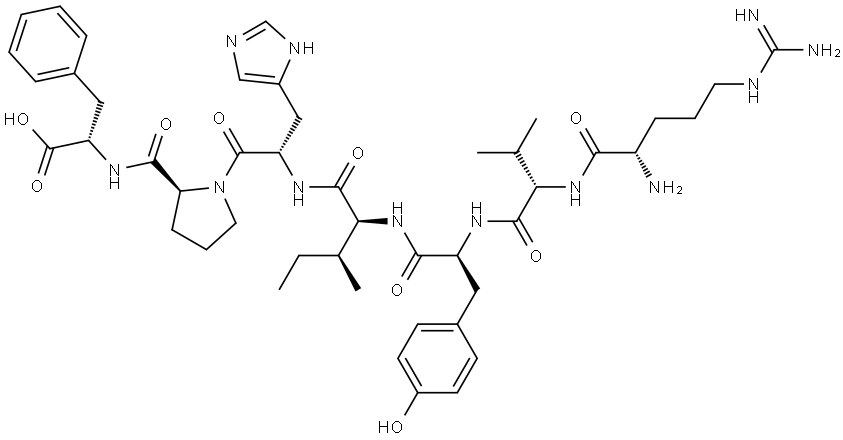
Description
Angiotensin III (Ang III) is a heptapeptide agonist at the angiotensin 1 (AT
1) and AT
2 receptors, with a 30-fold higher affinity for AT
2 compared with AT
1 in HEK293 cells. Ang III is the preferred agonist for renal AT
2 receptors, which are responsible for sodium excretion into the urine. Ang III induces the same level of aldosterone synthesis as Ang II but has lower vasoconstrictive activity
in vivo. In the brain renin-angiotensin system, Ang III increases sympathetic nerve activity and vasopressin release and dampens the baroreflex leading to higher blood pressure.
Uses
Angiotensin III, human, mouse is a heptapeptide, acts as an endogenous angiotensin type 2 receptor (AT2R) agonist, with IC50s of 0.648 nM and 21.1 nM for AT2R and AT1R, respectively.
Definition
ChEBI: Angiotensin III is a peptide.
in vivo
Angiotensin III (7, 14 and 28 nmol/kg/min) increases urine sodium excretion (UNaV), fractional excretion of sodium (FENa), and fractional excretion of lithium (FELi) in SD rat[2]. In RAS (renin-angiotensin system), Angiotensin III increases sympathetic nerve activity and vasopressin release and decreases the baroreflex leading to higher blood pressure in rats[3].
References
[1] Bosnyak S, et al. Relative affinity of angiotensin peptides and novel ligands at AT1 and AT2 receptors. Clin Sci (Lond). 2011 Oct;121(7):297-303. DOI:
10.1042/CS20110036[2] Kemp BA, et al. Intrarenal angiotensin III is the predominant agonist for proximal tubule angiotensin type 2 receptors. Hypertension. 2012 Aug;60(2):387-95. DOI:
10.1161/HYPERTENSIONAHA.112.191403[3] Gao J, et al. A new strategy for treating hypertension by blocking the activity of the brain renin-angiotensin system with aminopeptidase A inhibitors. Clin Sci (Lond). 2014 Aug;127(3):135-48. DOI:
10.1042/CS20130396