Description
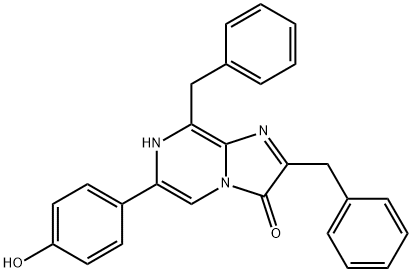
Coelenterazine-h (50909-86-9) may be used as a substrate in gene reporter assays, live cell assays, and biochemical assays (ELISA, BRET etc). Renilla luciferase catalyzes coelenterazine oxidation by oxygen to produce light. Coelenterazine-h produces 10-fold higher light output than native coelenterazine. Coelenterazine-h also undergoes autoluminescence, which is enhanced by superoxide anion and peroxynitrite in cells.
Uses
Coelenterazine h, is a derivative of Coelenterazine (C636000), and iis more sensitive to Ca2+ than is the native complex, thus providing a valuable tool for measuring small changes in Ca2+ concentrations.
Definition
ChEBI: Renilla luciferin is a member of phenols and an imidazopyrazine. It has a role as a luciferin. It derives from a hydride of an imidazo[1,2-a]pyrazine.
General Description
Coelenterazine is an imidazopyrazinone derivative. It is a substrate for bioluminescence in many luminous marine organisms.
Biochem/physiol Actions
10 times higher luminescence intensity than native coelenterazine.
References
[1] O SHIMOMURA Y K B Musicki. Semi-synthetic aequorins with improved sensitivity to Ca2+ ions.[J]. Biochemical Journal, 1989, 261 3: 913-920. DOI:
10.1042/bj2610913[2] J NAKAJIMA-SHIMADA. Monitoring of intracellular calcium in Saccharomyces cerevisiae with an apoaequorin cDNA expression system.[J]. Proceedings of the National Academy of Sciences of the United States of America, 1991, 88 15: 6878-6882. DOI:
10.1073/pnas.88.15.6878[3] SATOSHI INOUYE Frederick I T. Monitoring gene expression in Chinese hamster ovary cells using secreted apoaequorin[J]. Analytical biochemistry, 1992, 201 1: Pages 114-118. DOI:
10.1016/0003-2697(92)90182-7