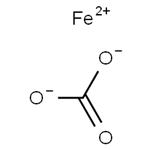
Synthesis
Laboratory method: Ferrous carbonate is often prepared by reacting alkali metal carbonate with ferrous salt solution. Hydrothermal method [2]: 0.002 mol FeSO4·7H2O and 0.010 mol urea are dissolved in 40 ml of deionized water and then transferred to a 50 ml polytetrafluoroethylene-lined stainless steel reactor and reacted at 160 °C for 4 h. The product was washed multiple times with deionized water and anhydrous ethanol, and finally dried at 60 °C for 12 h to obtain FeCO3
Waste acid method [3]: The waste acid obtained from the production of titanium dioxide by the sulfuric acid method was mixed with excess ferrous hydroxide to generate ferrous sulfate; the reaction solution was filtered to obtain a filtrate mainly containing ferrous sulfate; excess ammonium carbonate was added to the filtrate mainly containing ferrous sulfate to react, and ferrous carbonate was obtained by filtration.
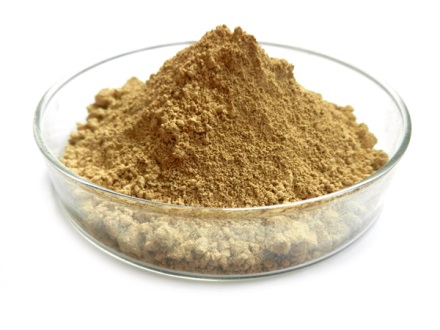
Figure 2: Ferrous carbonate
Description
§ 184.1307b(a) Ferrous carbonate (iron(II)carbonate, FeC03) is an odorless, white solid prepared by treating solutions of iron (II) salts with alkali carbonate salts. This substance is insoluble in water, but soluble in dilute acids.
Chemical Properties
White solid; odorless; gray solid.
Decomposes yielding CO2 + FeO at 2C. Insol in
H
2O; sol acids to give CO2; sol in H2O saturated
with CO
2 to give Fe(HCO3)2 which then oxidizes.
Chemical Properties
With monobasic acids relatively simple carboxylate salts are
formed. Iron(II) formate crystallizes as the green dihydrate; the white acetate
Fe(OCOCH3)2.4H20 is very soluble in water with some hydrolysis, the solution being
readily oxidized.
Uses
Ferrous Carbonate is a nutrient and dietary supplement that is a
source of iron.
Uses
Ferronil is used in preparation method of environmentally friendly composite stabilizer for heavy metal contaminated soil treatment.
Definition
ChEBI: A carbonate salt in which the counter-ion is iron in the +2 oxidation state.