Description
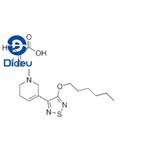
Muscarinic receptors are G protein-coupled acetylcholine receptors that play diverse roles. Xanomeline (oxalate) is a potent agonist of muscarinic acetylcholine receptors (EC
50 values are 0.3, 92.5, 5, 52, and 42 nM for M
1, M
2, M
3, M
4, and M
5, respectively). It has antipsychotic-
like activities in rats and
Cebus monkeys. M
1 selective agonists, like Xanomeline (oxalate), enhance memory function and has utility in treating Alzheimer’s Disease.
Uses
Xanomeline oxalate is a functionally selective mAChR M1 agonist.
in vivo
Xanomeline robustly stimulates in vivo PI hydrolysis and the effect is blocked by muscarinic antagonists, demonstrating mediation by muscarinic receptors. In mice the ED100 for Xanomeline-induced stimulation of [3H]-IP accumulation is 54 μmole/kg in hippocampus. And in rats the ED100 for Xanomeline-induced stimulation of [3H]-IP accumulation is 8.1 μmole/kg in hippocampus[1].
| Animal Model: | Male CF1 mice weighing 18-20 g are injected [3H]-myoinositol[1] |
| Dosage: | 8.1-81 μmole/kg |
| Administration: | S.c. injections; 1 h prior to killing and 1 h after the administration |
| Result: | Increased accumulation in a dose-related manner up to 130%, 75%, 60% above lithium levels in hippocampus, cortex and neostriatum, respectively. And did not increase accumulation of [3H]-IP in the brain stem.
Induced salivation, tremor and hypothermia in mice with the ED50 of 13.7±0.8 μmole/kg.
|
| Animal Model: | Rats are injected [3H]-myoinositol[1] |
| Dosage: | 2.7-81 μmole/kg |
| Administration: | S.c. injections; 1 h prior to killing and 1 h after the administration |
| Result: | Increased [3H]-IP formation dose dependently in hippocampus up to 221% above lithium control. |
storage
Desiccate at +4°C
References
[1] JULIA N. HEINRICH . Pharmacological comparison of muscarinic ligands: Historical versus more recent muscarinic M1-preferring receptor agonists[J]. European journal of pharmacology, 2009, 605 1: Pages 53-56. DOI:
10.1016/j.ejphar.2008.12.044[2] De Souza, F.I., Zumiotti, A.V., and Da Silva, C.F. Neuregulins 1-α and 1-β on the regeneration the peripheral nerves[J]. Acta Ortop Bras.
[3] MAIBRITT B ANDERSEN. The Muscarinic M1/M4 Receptor Agonist Xanomeline Exhibits Antipsychotic-Like Activity in Cebus apella Monkeys[J]. Neuropsychopharmacology, 2003, 28 6: 1168-1175. DOI:
10.1038/sj.npp.1300151[4] MESSER W S. The utility of muscarinic agonists in the treatment of alzheimer’s disease[J]. Journal of Molecular Neuroscience, 2002, 19 1-2: 187-193. DOI:
10.1007/s12031-002-0031-5

![3-[4-(Hexyloxy)-1,2,5-thiadiazol-3-yl]-1,2,5,6-tetrahydro-1-methylpyridineoxalate Structure](https://www.chemicalbook.com/CAS/GIF/141064-23-5.gif)