Chemical Properties
colourless liquid
Uses
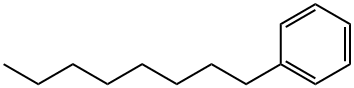
1-Phenyloctane is used as a solvent to study the self-assembly of derivatives of tetrathiafulvalene (TTF) on graphite and their visualization by scanning tunnelling microscopy (STM). It is also used to study the effects of the substitution of these compounds on the interactions between them.
Uses
n-octylbenzene is used as a solvent to study the self-assembly of derivatives of tetrathiafulvalene (TTF) on graphite and their visualization by scanning tunnelling microscopy (STM). It is also involved in the study the effects and substitution of these compounds. It is also used to prepare charge-transfer complexes with fluoranil and 1,3,5-trinitrobenzene.
General Description
Octylbenzene (1-Phenyloctane) forms charge-transfer complexes with fluoranil and 1,3,5-trinitrobenzene.
Synthesis
A 100 ml four-necked flask equipped with a mechanical stirrer, thermometer, nitrogen inlet and septum was charged with CuCl2 (40 mg, 0.3 nmol, 3 mol%), octyl bromide (1.93 g, 10 nmol, 1 equiv.), benzonitrile (103 mg, 1 nmol, 10 mol%) and THF (9 mL). The reaction mixture was cooled to -5 C. A t-BuMgCl solution was added to THF (10 mL, 1.2 M, 12 nmol, 1.2 eq.) using a syringe pump for 15 min (40 mL/h). The reaction mixture was heated to 10C. stirred for 2 hr. The solution was quenched with 1naq hydrochloric acid solution (20 ml). The aqueous phase was extracted with Et2O (3 x 20 mL). The combined organic layer was dried with MgSO4, filtered and concentrated under reduced pressure (0.13 bar) at ambient temperature. The crude residue was purified by silica gel (PE) flash column chromatography to afford 1-phenyloctane with purity >98%.