Synthesis
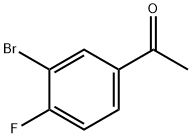
Example A5: Synthesis of 1-(3,5-dibromo-4-fluorophenyl)ethan-1-one and 1-(3-bromo-4-fluorophenyl)ethan-1-one
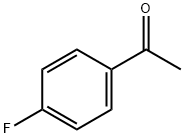
69 g (0.5 mol) of 4-fluoroacetophenone was slowly added dropwise to 200.0 g (1.5 mol) of finely powdered aluminum and heated to 70 °C with stirring. The reaction temperature was maintained at 75-80 °C for 20 min, followed by the slow addition of 184 g (1.15 mol) of bromine at the same temperature over a period of 2.5 hours. After completion of the reaction, the mixture was heated to 90 °C and maintained for 3 hours. After cooling, decolorization was carried out and then the mixture was partitioned between water and tert-butyl methyl ether. The organic phase was separated to give 130 g of brownish black oil. The oily substance was separated by column chromatography on toluene, using toluene as eluent, to give a two-part product:
a) 41.2 g (28% of theoretical yield) of colorless crystals with a melting point of 59-62 °C and an Rf = 0.53 (toluene). Identified by spectral analysis as 1-(3,5-dibromo-4-fluorophenyl)-1-ethanone. IR (KBr): 1685 (C=O) cm1; MS: M = 294/296/298 (Br). b) 41.2 g (28% of the theoretical yield) colorless crystals, melting point 59-62 °C, Rf = 0.53 (toluene).
b) 46.0 g (42% of theoretical yield) colorless crystals, melting point 52-55 °C, Rf = 0.41 (toluene). Identified by spectral analysis as 1-(3-bromo-4-fluorophenyl)-1-ethanone. IR (KBr): 1682 (C=O) cm1; MS: M = 216/218 (Br). c) 46.0 g (42% of theoretical yield) colorless crystals, melting point 52-55 °C, Rf = 0.41 (toluene).