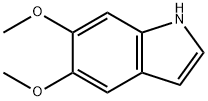
Chemical Properties
Beige powder
Uses
5,6-Dimethoxyindole is an indole derivative as analgesic antiinflammatory. It was used in the synthesis of N-benzyl-N-cyclopropyl-5,6-dimethoxyindole-3-glyoxalamide.
Application
5,6-Dimethoxyindole was used in the synthesis of N-benzyl-N-cyclopropyl-5,6-dimethoxyindole-3-glyoxalamide.
Reactant in synthesis of indolylhydroxyoxindoles via enantioselective Friedel-Crafts reaction
Reactant in synthesis of benzyl trimethoxyindoles
Reactant for synthesis of benzoylpiperazinyl-indolyl ethane dione derivatives as HIV-1 inhibitors
Reactant for synthesis of 1-aroylindole 3-aroylindoles combretastatin A-4 analogs as antitumor agents and tubulin polymerization inhibitors
Reactant for preparation of tryptophanol derivatives via the Grignard reaction
Synthesis Reference(s)
Journal of the American Chemical Society, 75, p. 5887, 1953
DOI: 10.1021/ja01119a030Synthesis of 5,6-Dimethoxyindoles and 5,6-Dimethoxyoxindoles. A New Synthesis of Indoles DOI:
10.1021/ja01619a049
Synthesis
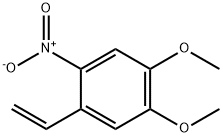
The general procedure for the synthesis of 5,6-dimethoxyindole from the compound (CAS: 65907-71-3) is as follows (note: use the Biotage Initiator for microwave reactions in a 2-5 mL reaction vessel): in a microwave reactor vial, an appropriate amount of o-nitrostyrene or o-nitrocinnamate (0.3 mmol) was combined with phosphine (2.4 equiv) A suspension was formed by stirring in anhydrous solvent (5 mL) and oxygen was excluded by bubbling argon into the mixture. The vessel was sealed by adding MoO2Cl2(dmf)2 (5 mol%). The reaction mixture was heated to the indicated temperature under microwave radiation and maintained for the corresponding time. Post-reaction treatments vary depending on the phosphine used: when triphenylphosphine is used, the solvent is removed under vacuum and the product is purified by column chromatography (hexane-EtOAc); when polystyrene-loaded triphenylphosphine is used, the reaction mixture is filtered and the solvent is removed under vacuum to obtain a pure indole; when 2-(diphenylphosphino)benzoic acid is used, the reaction mixture is filtered and washed with alkali if necessary. Post-reaction treatments of other phosphines were carried out with reference to the methods described in the literature [14] [15].
References
[1] Tetrahedron Letters, 2011, vol. 52, # 12, p. 1339 - 1342