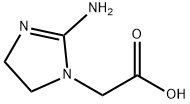
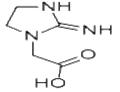
Cyclocreatine (500 mg/kg, i.v., a single dose for 60 min) restores heart contractile function and shows markedly less myocardial cell injury when compared to the control (saline) group in the acute myocardial infarction (AMI) intact dog model[1].
Cyclocreatine (0.28 mg/g, drink, supplementation daily from 10-week to 8 months) rescues microgliosis and clustering and moderates neurite dystrophy in TREM2/ 5XFAD mice[2].
Cyclocreatine (40 mg, gavage, daily for 1 month) significantly reduces liver metastatic burden and affects prostate cancer progression in a model of liver metastasis of mice[3].
| Animal Model: | AMI-intact dog model[1] |
| Dosage: | 500 mg/kg |
| Administration: | i.v., a single dose for 60 min |
| Result: | Preserved 85% of pre-ischemic ATP level (loss of only 15%) and 97% of the CrP (loss of 3%) during ischemia, as well as immediately restored over 80% of contractile function during the 2 h of reperfusion in AMI-intact dog model. |
| Animal Model: | 5XFAD and TREM2/ 5XFAD mice |
| Dosage: | 0.28 mg/g |
| Administration: | Drinking water supplementation with cyclocreatine daily from 10-week to 8 months |
| Result: | Improved microglial metabolism and the protective response to Aβ plaques in TREM2-deficient 5XFAD mice. |