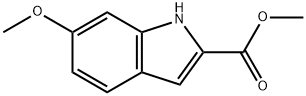
Chemical Properties
Pale pink crystals
Uses
Methyl 6-methoxy-2-indolecarboxylate is suitable for use in the production of dyes by
Escherichia coli expressing naphthalene dioxygenase (NDO) and toluene dioxygenase (TDO). It is also suitable for use in the production of dyes by
Escherichia coli expressing multicomponent phenol hydroxylase (mPH) from
Pseudomonas sp. strains KL33 and KL28.
Synthesis
General procedure for the synthesis of methyl 6-methoxy-1H-indole-2-carboxylate from compound (CAS: 98081-75-5): compound 10 (3 g, 13.9 mmol) was dissolved in xylene (42 mL) under refluxing conditions and slowly added dropwise to a preheated to refluxing solution of xylene (55 mL), the dropwise process lasted for 20 minutes. After the dropwise addition was completed, the reaction mixture was continued to be stirred at reflux for 6 hours. Upon completion of the reaction, the mixture was cooled to room temperature and subsequently concentrated under reduced pressure to remove the solvent. By recrystallization from benzene, compound 11a (1.97 g, 75% yield) was obtained as a white solid. Thin layer chromatography (TLC) analysis showed an Rf value of 0.40 (unfolding agent was hexane/ethyl acetate = 2:1).1H NMR (400 MHz, CDCl3) δ 8.82 (broad single peak, 1H), 7.56 (double peaks, 1H, J = 9.2 Hz), 7.36 (single peak, 1H), 7.16 (single peak, 1H), 6.83 (multiple peaks, 2H), and 3.93 (single peak, 3H), 3.86 (single peak, 3H).13C NMR (100 MHz, CDCl3) δ 162.4, 158.9, 138.0, 126.0, 123.4, 121.8, 112.3, 109.2, 93.6, 55.4, 51.8.
References
[1] Bioorganic and Medicinal Chemistry Letters, 2013, vol. 23, # 6, p. 1740 - 1742
[2] Journal of Organic Chemistry, 2009, vol. 74, # 17, p. 6442 - 6451
[3] Inorganic Chemistry, 2017, vol. 56, # 8, p. 4253 - 4257
[4] Chemical Communications, 2010, vol. 46, # 37, p. 6926 - 6928
[5] Bioorganic and Medicinal Chemistry Letters, 2011, vol. 21, # 10, p. 3057 - 3061