Uses
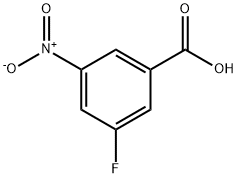
3-fluoro-5-nitrobenzoic acid is an industrial chemical with a variety of uses. It is used as an intermediate in the production of other chemicals and pharmaceuticals. 3-Fluoro-5-nitrobenzoic acid can be activated to form the corresponding sodium salt, which has been used as a reagent for organic synthesis. This chemical can also be used to produce n-oxides, such as phenoxides and nitrophenols. 3-Fluoro-5-nitrobenzoic acid is also used to synthesize industrial chemicals, including chlorides and benzene derivatives.
Synthesis
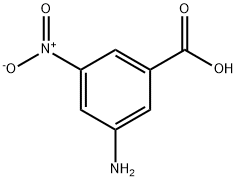
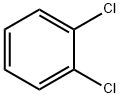
An acetonitrile (50 mL) slurry of nitrosonium tetrafluoroborate (3.53 g, 30.2 mM) was cooled in an ice bath under argon protection and stirred vigorously. Subsequently, 3-amino-5-nitrobenzoic acid (5.0 g, 27.5 mM) was added in three batches. When the addition was complete, the reaction mixture was gradually warmed to room temperature and stirred continuously for 48 hours. Upon completion of the reaction, 1,2-dichlorobenzene (50 mL) was added and the acetonitrile was removed by distillation under reduced pressure. Subsequently, the mixture was heated to 170°C and maintained for 30 minutes until the gas stopped escaping. After cooling, the reaction mixture was poured into dichloromethane (200 mL) and extracted with NaHCO3 solution. The aqueous phase was backwashed with dichloromethane, acidified with 2 M hydrochloric acid, and then the organic phase was extracted with ethyl acetate (2 x 100 mL). The organic layers were combined, washed with brine and dried with MgSO4. The crude product was purified by silica gel column chromatography using a gradient elution from dichloromethane/acetic acid (99:1) to dichloromethane/isopropanol/acetic acid (80:20:1), resulting in 3-fluoro-5-nitrobenzoic acid (3.26 g, 64% yield). The NMR hydrogen spectrum (DMSO-d6) data were as follows: δ 8.14 (dm, 1H); δ 8.37 (dt, 1H); δ 8.46 (m, 1H).