Uses
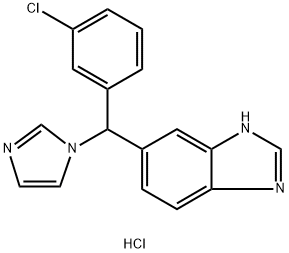
Liarozole (R75251) dihydrochloride is an imidazole derivative and orally active retinoic acid (RA) metabolism-blocking agent (RAMBA). Liarozole dihydrochloride inhibits the cytochrome P450 (CYP26)-dependent 4-hydroxylation of RA (IC50=7 μM), resulting in increased tissue levels of RA. Liarozole dihydrochloride shows antitumoral properties[1][2][3].
Biological Activity
Liarozole (R 75251, R75,251) is an orally active benzimidazole-based retinoic acid (RA) metabolism blocking agent (RAMBA) th at targets multiple P450 enzymes, including aromatase (CYP19), 17-hydroxylase/17,20-lyase (CYP17A1), 11-hydroxylase (CYP11B1), and RA 4-hydroxylase (CYP26). Liarozole is more effective than ketoconazole in vivo (plasma RA enhancement = 2.5 ng/mL vs. 1.3 ng/mL 2 hr after respective oral dosage of 40 mg/kg in rats) and, in contrast to ketoconazole, Liarozole does not significantly affect circulating adrenal androgen levels. Liarozole is shown to effectively suppress androgen-dependent tumor expansion of R3327G Dunning prostate adenocarcinoma xenografts in rats (by 66% and 81% with 80 and 120 mg/kg/day p.o., respectively) independent of its androgen biosynthesis inhibition.
References
[1] Kuijpers AL, et al. The effects of oral liarozole on epidermal proliferation and differentiation in severe plaque psoriasis are comparable with those of acitretin. Br J Dermatol. 1998;139(3):380-389. DOI:
10.1046/j.1365-2133.1998.02399.x[2] Lucker GP, et al. Oral treatment of ichthyosis by the cytochrome P-450 inhibitor liarozole. Br J Dermatol. 1997;136(1):71-75. PMID:9039298
[3] Wouters W, et al. Effects of liarozole, a new antitumoral compound, on retinoic acid-induced inhibition of cell growth and on retinoic acid metabolism in MCF-7 human breast cancer cells. Cancer Res. 1992;52(10):2841-2846. PMID:1581897
[4] Pignatello MA, et al. Liarozole markedly increases all trans-retinoic acid toxicity in mouse limb bud cell cultures: a model to explain the potency of the aromatic retinoid (E)-4-[2-(5,6,7,8-tetrahydro-5,5,8,8-tetramethyl-2-naphthylenyl)-1-propenyl] benzoic acid. Toxicol Appl Pharmacol. 2002; 178(3):186-194. DOI:
10.1006/taap.2001.9340[5] Van Wauwe J, et al. Liarozole, an inhibitor of retinoic acid metabolism, exerts retinoid-mimetic effects in vivo. J Pharmacol Exp Ther. 1992;261(2):773-779. PMID:1374473
[6] Stearns ME, et al. Liarozole and 13-cis-retinoic acid anti-prostatic tumor activity [published correction appears in Cancer Res 1993 Dec 1;53(23):5831]. Cancer Res. 1993;53(13):3073-3077. PMID:8319215