Description
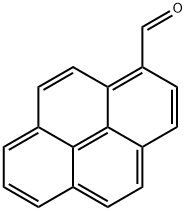
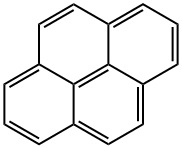
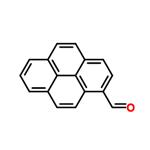
1-Pyrenecarboxaldehyde (PCA) is a bifunctional molecule containing a pyrene moiety and an aldehyde group. PCA can serve as a reducing agent capable of replacing toxic hydrazine in the chemical reduction of graphene oxide (GO). Numerous PCA molecules can be adsorbed onto the GO surface via strong π–π stacking and hydrophobic interactions between the pyrene moiety and the graphite plane. This successfully removes most of the oxygen-containing groups (such as epoxy and alkoxy groups) from the GO, thereby restoring the conjugated structure and electrical conductivity of graphene[6].
Chemical Properties
Dark Yellow Solid
Uses
A novel base-discriminating fluorescent (BDF) compound: a highly polarity-sensitive fluorophore for SNP typing.
Uses
1-Pyrenecarboxaldehyde is a important intermediate used in agrochemical, pharmaceutical and dyestuff field. It is used as a highly polarity-sensitive fluorophore for SNP typing.
Synthesis
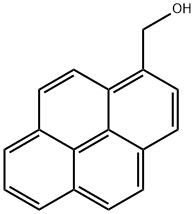
General procedure for the synthesis of 1-pyrenecarboxaldehyde from 1-pyrenemethanol: To a round-bottom flask were added 1-pyrenemethanol (2 mmol), copper trifluoromethanesulfonate (CuOTf, 0.1 mmol, 0.05 eq.), (S)-5-(pyrrolidin-2-yl)-1H-tetrazole (0.1 mmol, 0.05 eq.), 2,2,6,6-tetramethylpiperidine-1-yloxy ( TEMPO, 0.1 mmol, 0.05 eq.), 4-dimethylaminopyridine (DMAP, 0.15 mmol, 0.075 eq.) and acetonitrile (CH3CN, 5 mL). The reaction mixture was stirred and exposed to air at 25 °C until the reaction was completed, and the progress of the reaction was monitored by thin layer chromatography (TLC). After completion of the reaction, the acetonitrile was removed by evaporation under vacuum. The residue was diluted with dichloromethane (CH2Cl2, 5 mL) and filtered through a silica gel plug to obtain the target product 1-pyrenecarboxaldehyde.
Purification Methods
Recrystallise the aldehyde three times from aqueous EtOH. [Beilstein 7 IV 1821.]
References
[1] Chemical Communications, 2003, # 6, p. 758 - 759
[2] Inorganic Chemistry, 2016, vol. 55, # 12, p. 6114 - 6123
[3] Inorganic Chemistry, 2017, vol. 56, # 22, p. 14084 - 14100
[4] Tetrahedron, 2014, vol. 70, # 52, p. 9791 - 9796
[5] Chemistry - A European Journal, 2016, vol. 22, # 26, p. 8814 - 8822
[6] Yinjie Kuang. (2013). Synthesis of carboxylate-functionalized graphene nanosheets for high dispersion of platinum nanoparticles based on the reduction of graphene oxide via 1-pyrenecarboxaldehyde. Nanotechnology, 24 39, 395604.
https://doi.org/10.1088/0957-4484/24/39/395604