Description
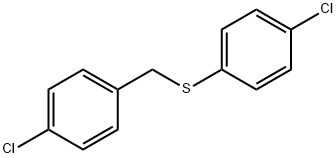
Chlorbenside is an obsolete organochlorine insecticide. It has a low aqueous solubility and is non-volatile. Little data is available regarding its environmental fate or ecotoxicology. Chlorbenside has a low mammalian oral toxicity.
Physical properties
Chlorbenside is a crystals; almond-like odor (technical
grade).Insoluble in water; soluble in
aromatic hydrocarbons, acetone. Resistant to acid
and alkaline hydrolysis.
Uses
Chlorbenside is a acaricide, especially for the control of eggs and larvae of red spider mites.
Definition
Generic name for an agricultural toxicant.
Production Methods
The industrial production of chlorbenside involves a nucleophilic substitution reaction where 4-chlorobenzyl chloride is reacted with 4-chlorothiophenol in the presence of a base, forming 1-chloro-4-[(4-chlorobenzyl)sulfanyl]benzene.
Health Hazard
Low to moderate toxicity in experimentalanimals from oral administration; chroniceffects may produce liver and kidney injuryin humans.
LD50 oral (rat): 2000 mg/kg.
Mechanism of action
Interferes with mitochondrial function disrupting the production of cellular energy
Pesticide Type
Acaricide; Miticide; Insecticide