Synthesis
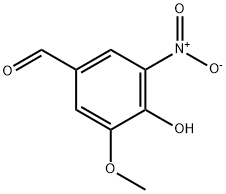
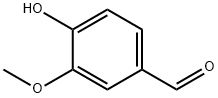
The general procedure for the synthesis of 5-nitrovanillin from vanillin was as follows: vanillin (94 mg, 1 mmol) was dissolved in 3 mL of glacial acetic acid in a 50 mL test tube. Solid Y(NO3)3-6H2O (383 mg, 1 mmol) was then added and the reaction mixture was shaken continuously for 10 min at room temperature. The reaction process was monitored by thin layer chromatography (TLC) in petroleum ether with 10% ethyl acetate. Upon completion of the reaction, 30 mL of ice-cold water was added to the reaction mixture and allowed to stand for 15 min. The solid product formed was collected by filtration and washed with cold water. The solid product obtained was used directly for analysis without further purification. The experimental methods for synthesizing compounds 2a-2e are detailed in Supporting Information.
Purification Methods
It forms yellow plates from AcOH and needles from EtOH [Slotta & Szyszke Chem Ber 68 184 1935]. With diazomethane, 5-nitro-3,4-dimethoxyacetophenone is formed [Brady & Manjunath J Chem Soc 125 1067 1924]. The methyl ether crystallises from EtOAc or AcOH, m 88o, 90-91o, and the phenylhydrazone has m 108-110o (from aqueous EtOH). [Finger & Schott J Prakt Chem [2] 115 288 1927.] The oxime has m 216o (from EtOH or AcOH), and the oxime acetate has m 147o (from aqueous EtOH) [Vogel Monatsh Chem 20 384 1899, Brady & Dunn J Chem Soc 107 1861 1915]. [Beilstein 8 III 2064.]
References
[1] Journal of Physical Organic Chemistry, 2000, vol. 13, # 9, p. 511 - 517
[2] Journal of Medicinal Chemistry, 2010, vol. 53, # 8, p. 3396 - 3411
[3] Tetrahedron Letters, 2006, vol. 47, # 15, p. 2507 - 2509
[4] Synthetic Communications, 2008, vol. 38, # 11, p. 1745 - 1752
[5] Tetrahedron, 1992, vol. 48, # 10, p. 1895 - 1910