Description
Galunisertib (LY2157299 monohydrate) is a small-molecule inhibitor of TGFβR1 that binds antagonistically to TGFR1 to prevent the intracellular phosphorylation of SMAD2 and SMAD3.Phase I studies have demonstrated that galunisertib had an acceptable tolerability and safety profile in patients with advanced solid tumors.Recently the preclinical studies from Tran et al. demonstrated that galunisertib combined with anti-GD2 antibody Dinutuximab augmented the anti-tumor cytotoxicity of activated NK(aNK) cells which were activated ex vivo with K562.mbIL21 artificial antigen presenting cells.Galunisertib suppressed SMAD2 phosphorylation and restored the expression of DNAX Accessory Molecule-1,NKp30, NKG2D and TNF-related apoptosis-inducing ligand death ligand expression on aNK cells and also significantly enhanced the release of perforin and granzyme A from aNK cells and the direct cytotoxicity and ADCC of aNK cells against neuroblastoma cells in vitro.The combination of galunisertib, aNK cells plus dinutuximab reduced tumor growth and increased survival of mice xenografted with two neuroblastoma cell lines or a patient derived xenograft.In another study,galunisertib was shown to preserve the cytotoxic function of ex vivo expanded, highly activated NK cells and significantly improved eradication of liver metastases of colon cancer in mice treated with adoptive NK cells compared with mice receiving NK cells or TGF beta inhibition alone. Overall these studies demonstrate that the therapeutic efficacy of adoptive NK cell therapy clinically will be markedly enhanced by complementary approaches targeting TGF-beta signaling in vivo.
Definition
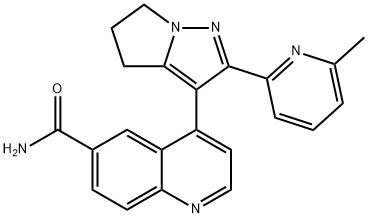
ChEBI: LY-2157299 is a pyrrolopyrazole that is 5,6-dihydro-4H-pyrrolo[1,2-b]pyrazole which is substituted at positions 2 and 3 by 6-methylpyridin-2-yl and 6-(aminocarbonyl)quinolin-4-yl groups, respectively. A Transforming growth factor-betaRI (TGF-betaRI) kinase inhibitor, it blocks TGF-beta-mediated tumor growth in glioblastoma. It has a role as a TGFbeta receptor antagonist and an antineoplastic agent. It is a member of quinolines, a pyrrolopyrazole, a member of methylpyridines, an aromatic amide and a monocarboxylic acid amide.
Synthesis
Methyl 4-(2-(6-methylpyridin-2-yl)-5,6-dihydro-4H-pyrrolo[1,2-b]pyrazol-3-yl)quinoline-6-carboxylate (raw material) was reacted with 60 mL of 7N ammonia-methanol solution in a stainless steel pressure vessel heated to 90°C for 66 hours. The pressure was raised to about 80 PSI during the reaction and needed to be maintained until the reaction was complete. At the end of the reaction, the vessel was cooled and the brown mixture was concentrated under vacuum. The residual solid was purified by passing through two 12 g Redi-Sep fast columns using acetone as eluent. The fractions containing the target product were collected and combined, followed by vacuum concentration. The resulting near-white solid was suspended in dichloromethane, diluted with the addition of hexane and filtered to afford the off-white solid product 4-[5,6-dihydro-2-(6-methyl-2-pyridinyl)-4H-pyrrolo[1,2-b]pyrazol-3-yl]-6- quinolinecarboxamide in a yield of 1.104 g and 63.8%. Mass spectral analysis showed ES + = 370 (M + 1).
References
[1] LOREA BUENO . Semi-mechanistic modelling of the tumour growth inhibitory effects of LY2157299, a new type I receptor TGF-β kinase antagonist, in mice[J]. European Journal of Cancer, 2008, 44 1: Pages 142-150. DOI:
10.1016/j.ejca.2007.10.008[2] LI ZHOU. Reduced SMAD7 leads to overactivation of TGF-beta signaling in MDS that can be reversed by a specific inhibitor of TGF-beta receptor I kinase.[J]. Cancer research, 2011: 955-963. DOI:
10.1158/0008-5472.can-10-2933[3] JORDI RODON. First-in-human dose study of the novel transforming growth factor-β receptor I kinase inhibitor LY2157299 monohydrate in patients with advanced cancer and glioma.[J]. Clinical Cancer Research, 2015, 21 3: 553-560. DOI:
10.1158/1078-0432.ccr-14-1380[4] STEPHAN HERBERTZ. Clinical development of galunisertib (LY2157299 monohydrate), a small molecule inhibitor of transforming growth factor-beta signaling pathway.[J]. Drug Design, Development and Therapy, 2015, 9: 4479-4499. DOI:
10.2147/dddt.s86621[5] ALBA A BRANDES. A Phase II randomized study of galunisertib monotherapy or galunisertib plus lomustine compared with lomustine monotherapy in patients with recurrent glioblastoma.[J]. Neuro-oncology, 2016, 18 8 1: 1146-1156. DOI:
10.1093/neuonc/now009[6] HUNG C TRAN. TGFβR1 Blockade with Galunisertib (LY2157299) Enhances Anti-Neuroblastoma Activity of the Anti-GD2 Antibody Dinutuximab (ch14.18) with Natural Killer Cells.[J]. Clinical Cancer Research, 2017, 23 1: 804-813. DOI:
10.1158/1078-0432.ccr-16-1743[7] FOLASHADE OTEGBEYE. Inhibiting TGF-beta signaling preserves the function of highly activated, in vitro expanded natural killer cells in AML and colon cancer models.[J]. PLoS ONE, 2018, 13 1: e0191358. DOI:
10.1371/journal.pone.0191358[8] RIKKE B HOLMGAARD. Targeting the TGFβ pathway with galunisertib, a TGFβRI small molecule inhibitor, promotes anti-tumor immunity leading to durable, complete responses, as monotherapy and in combination with checkpoint blockade.[J]. Journal for Immunotherapy of Cancer, 2018: 47. DOI:
10.1186/s40425-018-0356-4