Synthesis
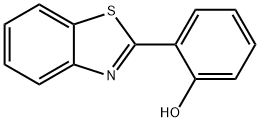
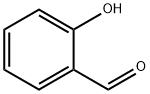
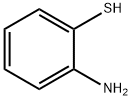
Robert G. Charles et al. used salicylamide and o-aminobenzylthiol as starting materials, reacted them in an oil bath at 220℃ for 4-5 h, and then obtained the final product 2-(2-hydroxyphenyl)benzothiazole after vacuum distillation, recrystallization purification, and drying, with a yield of 72% [1]. The reaction is shown in Figure 1. This synthetic route does not require the addition of solvent and is quick to operate, but the starting material o-aminobenzylthiol is highly toxic, and the reaction temperature is high, so protective measures must be taken during the operation.
Chemical Properties
Off-white to yellow powder
Uses
Fluorescent substances such as 2-(2-hydroxyphenyl)benzothiazole have been extensively studied by chemists worldwide as luminescent materials for OLEDs. 2-(2-hydroxyphenyl)benzothiazole is primarily used as a luminescent material.
Definition
ChEBI: 2-(1,3-benzothiazol-2-yl)phenol is a member of the class of benzothiazoles that is 1,3-benzothiazole substituted by a 2-hydroxyphenyl group at position 2. It has a role as a geroprotector. It is a member of phenols and a member of benzothiazoles.
Purification Methods
Recrystallise it several times from aqueous EtOH or dilute AcOH and sublime it. [Itoh & Fujiwara J Am Chem Soc 107 1561 1985, Bogert & Corbitt J Am Chem Soc 48 786 1926, Beilstein 27 II 91.]