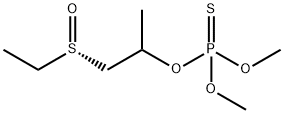
Production Methods
The industrial production process for oxydeprofos is not described in open literature. However, it can be inferred from its structure. It would typically begin with preparation of the O,O dimethyl phosphorothioate moiety, typically via chlorination of dimethyl phosphorothioic acid to form a reactive phosphoryl chloride intermediate. In parallel, the 2 (ethylsulfinyl)isopropyl thiol precursor would be generated by controlled oxidation of the corresponding thioether. These two fragments would then be coupled through S ester formation, producing the characteristic phosphorothioate–sulfoxide structure. After condensation, the crude material would be purified by washing and distillation to yield technical grade oxydeprofos