Uses
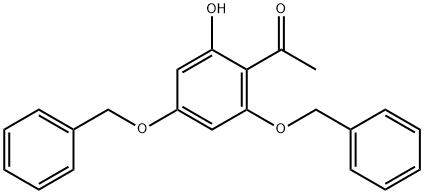
1-(2,4-bis(Benzyloxy)-6-hydroxyphenyl)ethanone is a useful reactant for the synthesis of fluorine-containing chalcone derivatives that have antiproliferative activity.
Preparation
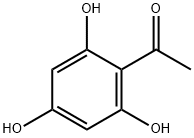
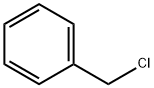
Preparation by reaction of benzyl chloride on phloroacetophenone with potassium carbonate in refluxing acetone (29%), (20%), in DMF at 100° (54%) and at 150–153° (26%) or in HMPA at 90–93° (80%).
Synthesis
The general procedure for the synthesis of 2-acetyl-3,5-bis(benzyloxy)phenol from 2',4',6'-trihydroxyacetophenone and benzyl chloride was as follows: to a solution of hexamethylphosphoramidite (HMPA, 300 mL) of 1-(2,4,6-trihydroxyphenyl)acetophenone (60 g, 0.36 mol) was added potassium carbonate (K2CO3, 148 g, 1.07 mol) and benzyl chloride (BnCl, 86.3 mL, 0.75 mol). The reaction suspension was stirred at 90 °C for 3 hours. After completion of the reaction, the solids were removed by filtration and the filtrate was poured into ice water. The pH of the mixture was adjusted to 2 by dropwise addition of dilute hydrochloric acid.Subsequently, the precipitated solid was collected by filtration and recrystallized in a solvent mixture of dichloromethane (CH2Cl2) and methanol (MeOH) to afford 1-(2,4-bis(benzyloxy)-6-hydroxyphenyl)ethanone. The product yield was 75%; 1H NMR (CDCl3, 300 MHz) δ: 2.56 (3H, s), 5.06 (4H, s), 6.11 (1H, s), 6.17 (1H, s), 7.41 (10H, m), 14.04 (1H, s).
References
[1] Journal of Chemical Research - Part S, 1999, # 2, p. 148 - 149
[2] Indian Journal of Chemistry, Section B: Organic Chemistry Including Medicinal Chemistry, 1987, vol. 26, # 1-12, p. 488 - 490
[3] Synthesis, 2010, # 16, p. 2776 - 2786
[4] Bioorganic and Medicinal Chemistry, 2010, vol. 18, # 8, p. 2864 - 2871
[5] Biochemical Pharmacology, 2014, vol. 92, # 2, p. 358 - 368