Synthesis
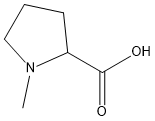
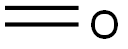
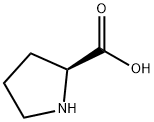
GENERAL METHOD: L-proline (2.0 g, 17.4 mmol) was dissolved in methanol (20 mL), to which 40% aqueous formaldehyde (1.4 mL, 19.1 mmol) was subsequently added. Next, 10% Pd/C catalyst (500 mg) was added to the reaction mixture and the resulting slurry was stirred overnight under hydrogen atmosphere. Upon completion of the reaction, the slurry was filtered through a diatomaceous earth pad to remove the catalyst. The diatomaceous earth pad was washed with methanol and the filtrates were combined and concentrated under reduced pressure. The residue was dissolved in a solvent mixture of ethanol/benzene (1:1, 100 mL) and concentrated again under reduced pressure to give a solid product. Finally, the product was purified by recrystallization from methanol/ether mixed solvent to give N-methyl-L-proline (7a) as fine needle-like crystals (2.1 g, 92% yield); melting point 109-111 °C; 1H NMR (D2O, 300 MHz): δ= 3.95-3.90 (1H, m, CH2(CH2)2CHNCH3), 3.24-3.15 (2H , m, CH2(CH2)2CHNCH3), 2.97 (3H, s, CH2(CH2)2CHNCH3), 2.22-2.01 (4H, m, CH2(CH2)2CHNCH3); ESI-MS (m/z): 130.2 [M + H]+ (100).
References
[1] Journal of Organic Chemistry, 2003, vol. 68, # 7, p. 2652 - 2667
[2] Green Chemistry, 2016, vol. 18, # 16, p. 4374 - 4392
[3] European Journal of Organic Chemistry, 2005, # 5, p. 934 - 938
[4] Tetrahedron Letters, 2007, vol. 48, # 43, p. 7680 - 7682
[5] Medicinal Chemistry Research, 2016, vol. 25, # 6, p. 1148 - 1162