Uses
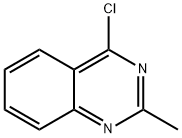
4-Chloro-2-methylquinazoline is primarily used as a key intermediate in pharmaceutical research and chemical biology studies, particularly in the synthesis of novel drug molecules with biological activities such as anti-tumor and antibacterial effects.
Synthesis
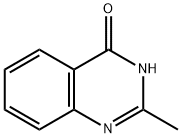
The general procedure for the synthesis of 4-chloro-2-methylquinazoline from 4-hydroxy-2-methylquinazoline was as follows: first, starting from commercially purchased 2-methylquinazolin-4(3H)-one, the chlorination reaction was carried out at the 4-position using POCl3 according to the microwave-assisted procedure as previously reported [25], which ultimately afforded 4-chloro-2-methylquinazoline in 73% yield. Subsequently, the product was applied to the synthesis of the intermediate according to the general DMAP-catalyzed procedure described in κ 3.1.3 to give molecule 37 as a beige powder in 45% yield. The melting point of the product was 118 °C (isopropanol).1H NMR (200 MHz, CDCl3) δ = 8.33 (d, J = 8 Hz, 1H), 7.95-7.83 (m, 3H), 7.65-7.56 (m, 2H), 7.42-7.25 (m, 2H), 2.59 (s, 3H), 2.47 (s, 3H).13C NMR (50 MHz, CDCl3) δ=197.9,166.3,163.7,152.0,150.9,134.3,133.3,132.0,130.1,127.1,127.0,126.0,123.8,123.4,114.3,30.1,26.2. LC-MS (ESI+) tR 4.60 min, m/z [M+H]+ 279.19. molecular weight: 278.31 g/mol. calculated value of C17H14N2O2: C, 73.37; H, 5.07; N, 10.07. measured value: C, 73.82; H, 5.11; N, 9.93.
References
[1] Synthetic Communications, 2011, vol. 41, # 24, p. 3644 - 3653
[2] Indian Journal of Chemistry - Section B Organic and Medicinal Chemistry, 2009, vol. 48, # 6, p. 840 - 847
[3] MedChemComm, 2013, vol. 5, # 11, p. 1700 - 1707
[4] Tetrahedron, 2014, vol. 70, # 44, p. 8257 - 8266
[5] European Journal of Medicinal Chemistry, 2016, vol. 119, p. 34 - 44