
67684-64-4
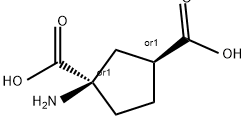
基本信息
Trans-(±)-ACP
TRANS-(±)-ACPD
TRANS-(+/-)-ACPD
(+/-)-TRANS-ACPD
trans-(±)-ACPD monohydrate
TRANS(+-)-ACPD EXCITATORY AMINO ACID
TRANS-(+/-)-1-AMINO-1,3-CYCLOPENTANEDICARBOXYLIC ACID
(+/-)-1-AMINOCYCLOPENTANE-TRANS-1,3-DICARBOXYLIC ACID
(+/-)-1-Aminocyclopentanl-trans-1,3-Dicarboxylic acid
物理化学性质
| 沸点 | 352.7±42.0 °C(Predicted) |
| 密度 | 1.452±0.06 g/cm3(Predicted) |
| 储存条件 | Keep in dark place,Inert atmosphere,2-8°C |
| 溶解度 | 水中的溶解度为1mg/mL |
| 酸度系数(pKa) | 2.11±0.40(Predicted) |
| 形态 | 固体 |
| 颜色 | 白色 |
| 水溶解性 | Soluble to 5 mM in water with gentle warming and to 50 mM in 1eq. NaOH |
| InChI | 1S/C7H11NO4.H2O/c8-7(6(11)12)2-1-4(3-7)5(9)10;/h4H,1-3,8H2,(H,9,10)(H,11,12);1H2/t4-,7+;/m1./s1 |
| InChIKey | AZRMVYVZWAKHMR-RERZVJIGSA-N |
| SMILES | O.N[C@]1(CC[C@H](C1)C(O)=O)C(O)=O |
安全数据
| 危险性符号(GHS) |  GHS07 |
| 警示词 | 警告 |
| 危险性描述 | H302+H312+H332 |
| 防范说明 | P261-P264-P280-P301+P312-P302+P352+P312-P304+P340+P312 |
| 危险品标志 | Xn |
| 危险类别码 | 20/21/22 |
| WGK Germany | 3 |
| 存储类别 | 13 - Non Combustible Solids |
| 危险性类别 | Acute Tox. 4 Dermal Acute Tox. 4 Inhalation Acute Tox. 4 Oral |
(±)-TRANS-ACPD价格(试剂级)
| 报价日期 | 产品编号 | 产品名称 | CAS号 | 包装 | 价格 |
| 2026/09/15 | HY-19434 | (±)-TRANS-ACPD trans-ACPD | 67684-64-4 | 1 mg | 365元 |
| 2026/09/15 | HY-19434 | (±)-TRANS-ACPD trans-ACPD | 67684-64-4 | 5mg | 830元 |
| 2026/09/15 | HY-19434 | (±)-TRANS-ACPD trans-ACPD | 67684-64-4 | 10mM * 1mLin DMSO | 913元 |
常见问题列表
|
mGluR
|
Excitatory amino acid (EAA) analogues activate receptors that are coupled to the increased hydrolysis of phosphoinositides (PIs). In these studies, hippocampal slices are prepared from neonatal rats (6-11 days old) to characterize the effects of EAA analogues on these receptors. The concentrations of trans-ACPD required to evoke half-maximal stimulation (EC 50 value) is 51 μM. DL-2-Amino-3-phosphonopropionate (DL-AP3) is also equipotent as an inhibitor of PI hydrolysis stimulated by ibotenate, quisqualate, and trans-ACPD (IC 50 values are 480-850 μM).
Intrathecal injection of NMDA, kainate, and trans-ACPD, TNF-α, or IL-1β causes significant (p<0.001) biting behaviour in mice compared to animals injected intrathecally with saline. In all groups, systemic pre-treatment with GM (100 mg/kg, i.p.) significantly (p<0.001) reduces the biting behaviour compared to mice treated with saline (10 mL/kg, i.p.). The greatest effect of GM is observed on the pro-inflammatory cytokines and NMDA, with the following inhibition percentages: TNF-α (92±7%), IL-1β (91±5%), NMDA (69±1%), and trans-ACPD (71±12%). By contrast, at the same dose, GM has no significant effect on the kainate-mediated biting response.