
130089-98-4
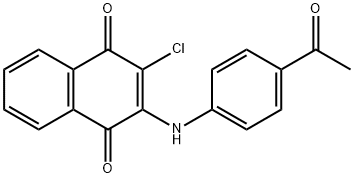
基本信息
NQ 301
NQ-301
NQ301 >=98% (HPLC)
NQ301 - Compound 211
2-(4-Acetylanilino)-3-chloronaphthalene-1,4-dione
2-((4-acetylphenyl)amino)-3-chloronaphthalene-1,4-dione
2-[(4-Acetylphenyl)amino]-3-chloro-1,4-naphthalenedione
1,4-Naphthalenedione, 2-[(4-acetylphenyl)amino]-3-chloro-
物理化学性质
| 熔点 | 241-243 °C(Solv: ethanol (64-17-5)) |
| 沸点 | 476.8±45.0 °C(Predicted) |
| 密度 | 1.40±0.1 g/cm3(Predicted) |
| 储存条件 | 2-8°C |
| 溶解度 | DMSO:10.0(Max Conc. mg/mL);30.7(Max Conc. mM) |
| 酸度系数(pKa) | -5.25±0.20(Predicted) |
| 形态 | 粉末 |
| 颜色 | 淡红色至深红色 |
| InChI | 1S/C18H12ClNO3/c1-10(21)11-6-8-12(9-7-11)20-16-15(19)17(22)13-4-2-3-5-14(13)18(16)23/h2-9,20H,1H3 |
| InChIKey | LSQZKIQSQHZVQS-UHFFFAOYSA-N |
| SMILES | O=C1C(Cl)=C(NC2=CC=C(C(C)=O)C=C2)C(C3=CC=CC=C31)=O |
安全数据
| 危险性符号(GHS) |   GHS07,GHS09 |
| 警示词 | 警告 |
| 危险性描述 | H315-H319-H335-H400 |
| 防范说明 | P273-P280-P304+P340+P312-P305+P351+P338-P337+P313-P391 |
| 危险品运输编号 | UN 3077 9 / PGIII |
| WGK Germany | WGK 3 |
| 存储类别 | 11 - Combustible Solids |
| 危险性类别 | Aquatic Acute 1 Eye Irrit. 2 Skin Irrit. 2 STOT SE 3 |
NQ301价格(试剂级)
| 报价日期 | 产品编号 | 产品名称 | CAS号 | 包装 | 价格 |
| 2026/09/15 | HY-101054 | NQ301 NQ301 | 130089-98-4 | 5mg | 600元 |
| 2026/09/15 | HY-101054 | NQ301 NQ301 | 130089-98-4 | 10mM * 1mLin DMSO | 660元 |
| 2026/09/15 | HY-101054 | NQ301 NQ301 | 130089-98-4 | 10mg | 900元 |
常见问题列表
| Target | Value |
|
TXA2 receptor
() | |
|
CD45
(Cell-free assay) | 200 nM |
NQ301 concentration-dependently inhibits collagen (10 mg/mL)-, U46619 (1 mg/mL)- and arachidonic acid (100 mg/mL)-challenged rabbit platelet aggregation, with IC 50 values of 0.60±0.02, 0.58±0.04 and 0.78±0.04 μM, respectively. NQ301 potently suppresses thromboxane B 2 formation by platelets that are exposed to arachidonic acid in a concentration-dependent manner, but had no effect on the production of prostaglandin D 2 , indicating an inhibitory effect on thromboxane A 2 synthase. NQ301 has a potential to inhibit thromboxane A 2 synthase activity with thromboxane A 2 /prostaglandin H 2 receptor blockade, and modulate arachidonic acid liberation as well as 12-hydroxy-5,8,10,14-eicosatetraenoic acid formation in platelets. NQ301 inhibits platelet aggregation by suppression of the intracellular pathway, rather than by direct inhibition of fibrinogen-GPIIb/IIIa complex binding. NQ301 significantly inhibits the increase of cytosolic Ca 2+ concentration and ATP secretion, and also significantly increases platelet cAMP levels in the activated platelets. The antiplatelet activity of NQ301 may be mediated by inhibition of cytosolic Ca 2+ mobilization, enhancement of cAMP production and inhibition of ATP secretion in activated platelets.