
102-02-3
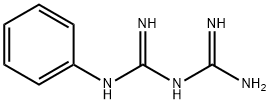
基本信息
N-PHENYLIMINODICARBONIMIDIC-DIAMIDE
PHENYLBIGUANIDE
1-phenyl-biguanid
n-phenyl-n’-guanylguanidine
p1426
phenyl-biguanid
phenyldiguanide
2-(N2-Phenylamidino)guanidine
物理化学性质
| 熔点 | 135-142 °C(lit.) |
| 沸点 | 299.13°C (rough estimate) |
| 密度 | 1.2512 (rough estimate) |
| 折射率 | 1.6900 (estimate) |
| 储存条件 | Keep in dark place,Sealed in dry,Room Temperature |
| 溶解度 | 易溶于酒精 |
| 酸度系数(pKa) | 10.76, 2.13(at 25℃) |
| 形态 | 粉末晶体 |
| 颜色 | 白色至橙色再至绿色 |
| Merck | 7276 |
| InChI | 1S/C8H11N5/c9-7(10)13-8(11)12-6-4-2-1-3-5-6/h1-5H,(H6,9,10,11,12,13) |
| InChIKey | CUQCMXFWIMOWRP-UHFFFAOYSA-N |
| SMILES | NC(=N)\N=C(/N)Nc1ccccc1 |
| CAS 数据库 | 102-02-3(CAS DataBase Reference) |
安全数据
| 危险性符号(GHS) |  GHS07 |
| 警示词 | 警告 |
| 危险性描述 | H302-H315-H319-H335 |
| 防范说明 | P261-P301+P312-P302+P352-P304+P340-P305+P351+P338 |
| WGK Germany | 3 |
| RTECS号 | DU2450000 |
| 海关编码 | 2925.29.6000 |
| 存储类别 | 11 - Combustible Solids |
图谱信息
1-苯基双胍(102-02-3)核磁图(1HNMR)1-苯基双胍(102-02-3)Raman光谱1-苯基双胍(102-02-3)傅里叶红外光谱图1-苯基双胍(102-02-3)红外图谱(IR)知名试剂公司产品信息
Phenylbiguanide,>93.0%(T)(102-02-3) TCI Shanghai
1-苯基双胍价格(试剂级)
| 报价日期 | 产品编号 | 产品名称 | CAS号 | 包装 | 价格 |
| 2026/09/15 | HY-101331R | 1-苯基双胍 Phenylbiguanide (Standard) | 102-02-3 | 10 mg | 606元 |
| 2026/09/15 | HY-101331R | 1-苯基双胍 Phenylbiguanide (Standard) | 102-02-3 | 25 mg | 1030元 |
| 2026/09/15 | HY-101331 | 1-苯基双胍 Phenylbiguanide | 102-02-3 | 10 mg | 100元 |
常见问题列表
| Target | Value |
|
5-HT3 receptor
(Cell-free assay) | 3.0 μM(EC50) |
Phenylbiguanide (1-Phenylbiguanide) is a 5-HT 3 receptor selective agonist with pEC 50 s of 5.57, 4.07, and 4.47 for r5-HT 3A(b) , h5-HT 3A , m5-HT 3A(b) , respectively. The effect of Phenylbiguanide (1-Phenylbiguanide hydrochloride) in promoting the growth of the HT29 cell line is investigated. Phenylbiguanide causes a dose dependent proliferation of HT29 cells after 48 hours incubation. The maximum proliferation is at a 5HT concentration of 12.5 μM (P≤0.01). Phenylbiguanide significantly stimulates the growth of cells at concentrations of 3.125 μM (P≤0.05) and 6.25 μM (P≤0.01).
In anaesthetised mice, Phenylbiguanide (PBG), a drug that is known to stimulate cardiopulmonary afferent C-fibres,is injected into the right atrium of the heart and mapped c-Fos expression within specific regions of the central nervous system. Intraatrial injection of PBG produces a reflex cardiorespiratory response including a pronounced bradycardia and a respiratory depression.