Description
Aldimorph is an obsolete fungicide that is not generally approved for use in the developed world. It has a low mammalian toxicity but may be a teratogen. It has a moderate aqueous solubility and volatile. Little published data is available regarding its environmental degradation. Aldimorph is moderately toxic to fish.
Definition
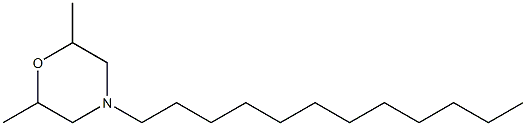
ChEBI: 4-dodecyl-2,6-dimethylmorpholine is a member of the class of morpholines that is 2,6-dimethylmorpholine in which the hydrogen attached to the nitrogen is replaced by a dodecyl group. The configuration at positions 2 and 6 is unknown or unspecified. It has a role as an antifungal agrochemical. It is a member of morpholines and a tertiary amino compound. It contains a dodecyl group.
Production Methods
The commercial production of aldimorph begins with the synthesis of dodecylamine, which serves as the alkylating agent. This is reacted with bis(2-chloroisopropyl) ether, a bifunctional reagent that introduces the morpholine ring structure through nucleophilic substitution. The reaction proceeds under controlled conditions, typically in an organic solvent and in the presence of a base, to form a mixture of 4-alkyl-2,6-dimethylmorpholines and 4-alkyl-2,5-dimethylmorpholines, with the dodecyl group being the dominant alkyl chain.
Mechanism of action
Systemic with protective and curative action, inhibits sterol biosynthesis in membranes. Absorbed through leaves and roots.