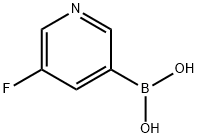
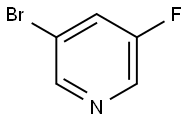
General procedure for the synthesis of 5-fluoro-3-pyridineboronic acid from 3-bromo-5-fluoropyridine: 3-bromo-5-fluoropyridine (25 Kg, 142 moles, 1.0 eq.), THF (222.5 Kg), and isopropyl borate (28 Kg, 149.3 moles, 1.05 eq.) were added to a 700 L cryogenic reactor. The resulting mixture was cooled to -90°C to -80°C with continuous stirring. Subsequently, n-butyllithium (40.2 Kg, 2.5 M, 142 moles, 1.0 eq.) was added dropwise at a rate of 2 Kg/h and it was ensured that the reaction temperature was maintained below -87 °C. After the dropwise addition was completed, the reaction mixture was kept at -88 °C to -83 °C for 2.5 hours. After confirming the completion of the reaction by HPLC analysis, a 9% aqueous hydrochloric acid solution (7.7 Kg) was added to quench the reaction. The mixture was transferred to a 1000 L glass-lined reactor to bring the temperature back to -20°C to -10°C. Next, additional hydrochloric acid solution (122.3 Kg) was added until the pH was adjusted to 1-2, during which time the temperature was maintained at 0-10°C. The mixture was kept under these conditions for 0.5 hours to promote phase separation. After separation of the organic layer, it was washed with saturated brine (38 Kg), stirred for 0.5 h and left for another 0.5 h to achieve phase separation. The aqueous layer was separated and the combined aqueous layers were extracted twice with ethyl acetate (51Kg and 25Kg). After separation of the organic phase, the pH was adjusted to 6 with 30% aqueous sodium hydroxide (27.4 Kg). at this pH, the solid product precipitated. The slurry was filtered by centrifugation and dried in a disk drier at 40-45°C to give 5-fluoro-3-pyridineboronic acid as a white solid (17.5 Kg, yield 87.4%, purity: 98.6% AUC, determined using Method B).