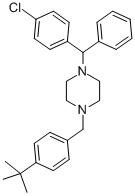
Definition
ChEBI: An N-alkylpiperazine carrying (4-chlorophenyl)(phenyl)methyl and 4-tert-butylbenzyl groups.
Chemical Properties
White crystalline powder. Melting point 230-240°C (221-225°C). Insoluble in water, soluble in ethanol and chloroform, boiling point 217-220°C (0.133 kPa). Its hydrochloride (C????H????CIN??·2HCl=505.98), also known as Anqimin, has a melting point of 265-266°C.
Uses
Buclizine is an antinauseant.
Manufacturing Process
1 mol 4-chlorobenzhydril chloride was heated in toluene to reflux with 1 mol
ethyl ester of piperazine 1-carboxylic acid at about 150°C in a presence of an
excess of triethyl amine. On cooling the triethyl amine hydrochloride was
filtered off, a solvent was removed in vacuum and the residue [(4-chlorophenyl)-
phenyl-methyl]piperazine carboxylic acid ethyl ester was boiled
straight away with potassium hydroxide in ethanol for 48 hours. After
removing ethanol in vacuum to dryness, the residue was dissolved in benzene
and washed with water. The benzene solution was dried, benzene removed in
vacuum. The residue was distilled to give 4-chlorobezhydryl-piperazine. It had
given the desired 1-(p-tert-butylbenzyl)-4-(p-chloro-α-phenylbenzyl)-
piperazine, buclizine, by a reaction with 4-tert-butylbenzyl chloride in the
presence of any halogen hydrochloride acceptor (triethyl amine, sodium or
potassium carbonate and so on). The obtained product had BP: 230°-
240°C/0.001 mm Hg.
Brand name
Bucladin (Stuart).
Therapeutic Function
Antihistaminic, Antiallergic, Antinauseant,
Tranquilizer, Appetite stimulant
Synthesis
Buclizine is mainly used
in the prevention of motion sickness and in combination
with analgesics for treatment of migraine.