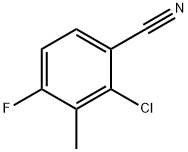
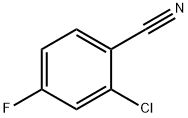
General procedure for the synthesis of 2-chloro-3-methyl-4-fluorobenzonitrile from 2-chloro-4-fluorobenzonitrile and iodomethane: First, a tetrahydrofuran (THF, 1 L) solution of diisopropylamine (80.6 mL, 0.575 mol) was cooled down to about -5 °C in an ice water/methanol bath. Subsequently, n-butyllithium (2.5 M hexane solution, 212 mL, 0.530 mol) was slowly added over a period of 1 h using a syringe pump (4 mL/min) while maintaining the reaction temperature between -5 and 0°C. The lithium diisopropylammonium (LDA) solution was stirred at 0 °C for 1 h and then transferred to a THF (1 L) solution of 2-chloro-4-fluorobenzonitrile (68.7 g, 0.442 mol) pre-cooled to -78 °C via cannulae over a 1 h period. The temperature of the reaction mixture may rise to about -65 °C during the initial addition of the LDA solution, but the internal temperature needs to be ensured to be below -70 °C during the remaining LDA addition. The temperature of the resulting dark red-orange reaction mixture was maintained below -70 °C for 5 h. Iodomethane (251.2 g, 1.77 mol) was then added at a rate of about 3 mL/min, with the rate of addition being controlled to maintain the reaction temperature below -65 °C. Afterwards, the reaction mixture was allowed to slowly warm up overnight. After stirring for 14 hours, the temperature of the reaction mixture reached -5 °C. The reaction was quenched with saturated aqueous ammonium chloride solution (500 mL) and water (750 mL) and diluted with ether (~2 L). Separate the organic and aqueous layers and the aqueous layer was then extracted with ether (about 1 L). The organic layers were combined (ca. 5.5 L), dried with anhydrous magnesium sulfate, filtered and concentrated to give the crude product 2-chloro-3-methyl-4-fluorobenzonitrile as a reddish brown oily solid (ca. 86.7 g). The crude product was purified by silica gel column chromatography (silica gel column size: 10×30 cm, eluent gradient: 99:1 to 93:7 hexane/ethyl acetate) to afford the pure product 2-chloro-3-methyl-4-fluorobenzonitrile (56.7 g, 76% yield) as a white solid with a melting point of 63-65 ° C; 1H NMR (300 MHz, CDCl3): δ 7.54 (dd. J = 8.6, 5.6 Hz, 1H), 7.08 (dd, J = 8.6, 8.6 Hz, 1H), 2.36 (d, J = 2.4 Hz, 3H).