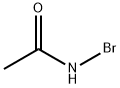
General Description
White powder.
Reactivity Profile
N-BROMOACETAMIDE(79-15-2) is sensitive to light, moisture, and heat. . N-BROMOACETAMIDE(79-15-2) decomposes rapidly at elevated temperatures, in the presence of moisture and light.
Air & Water Reactions
Soluble in water.
Fire Hazard
Flash point data are not available for this chemical, but N-BROMOACETAMIDE is probably combustible.
Uses
Abolishes the rapid inactivation of membrane sodium- and potassium-ion channels.
Production Methods
N-bromoacetamide was produced as a specialty halogenated biocide, not as a large volume agricultural pesticide, so its commercial manufacture followed the small scale fine chemical model typical of reactive bromine compounds. Production relied on the controlled bromination of acetamide, usually by adding bromine or a brominating agent (such as sodium hypobromite) to acetamide under chilled, acidic, and moisture controlled conditions to prevent over bromination or decomposition. The reaction mixture was then neutralised, filtered, and crystallised to yield technical grade compound.
Mechanism of action
Disrupts mitochondrial function and so damages cellular structures
Purification Methods
A possible contaminant is CH3CONBr2. Recrystallise it from CHCl3/hexane (1:1, seed if necessary) or water and dry over CaCl2. It is a brominating agent. [Oliveto & Gerold Org Synth Coll Vol IV 104 1963.] Alternatively, dissolve it in the minimum volume of warm H2O (60o), then cool in an ice bath, collect the crystals and dry them in an anhydrous atmosphere, dissolve in Et2O, chill and evaporate till crystallisation. Dry the crystals in vacuo at 25o, then at 45o (m 108o). Crystallise from CHCl3 (m 103o). Estimate the available Br iodometrically [Buckles et al. J Org Chem 23 483 1958]. [Beilstein 2 H 181, 2 I 82, 2 II 180, 2 III 406, 2 IV 417.]
Pesticide Type
Molluscicide; Insecticide