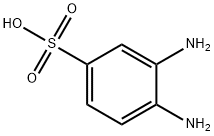
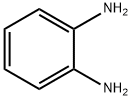
The general procedure for the synthesis of 3,4-diaminobenzenesulfonic acid from o-phenylenediamine was as follows: first, the sulfonation mixture was prepared by dissolving 160 g (1.48 mol) of 1,2-diaminobenzene in 800 g (435 mL; 8.16 mol) of 95-97% sulfuric acid. Subsequently, the sulfonated mixture was divided into four portions and pumped into a continuous flow microreactor for the reaction. The microreactor consisted of a sequentially connected inlet module, five residence modules and an outlet module, each of which was maintained at a constant reaction temperature. Upon completion of the reaction, the sulfonation mixture was rapidly cooled with water at the reactor outlet to allow the sulfonation reaction products to precipitate in an ice-water bath. After filtration, the resulting white product was characterized by nuclear magnetic resonance (NMR). Based on 1H-NMR spectroscopy (400 MHz, DMSO-d6) analysis, no isomers were detected in all the products isolated in the experiments, confirming the formation of 3,4-diaminobenzenesulfonic acid and the absence of impurities. The yields of the products were influenced by the reaction temperature and residence time: 80% at 160 °C reaction temperature for 25 min, 89%, 90% and 100% at 180 °C reaction temperature for 5, 10 and 25 min, respectively.