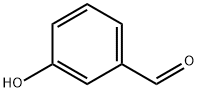
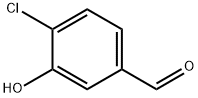
3-Hydroxybenzaldehyde (1 g, 10 mmol) was used as starting material and dissolved in acetonitrile (50 mL). To this solution, p-toluenesulfonic acid was added in batches at room temperature and after stirring for 5 minutes, N-chlorosuccinimide (NCS, 1.33 g, 10 mmol) was added. The reaction mixture was continued to be stirred at room temperature for 2 hours. Upon completion of the reaction, the reaction was quenched with aqueous sodium thiosulfate, followed by dilution with ethyl acetate and saturated saline. The organic layer was separated, dried with anhydrous sodium sulfate and concentrated under reduced pressure to give the crude product. The crude product was purified by silica gel column chromatography with the eluent of petroleum ether/ethyl acetate (10:1 to 5:1) to afford 2-chloro-5-hydroxybenzaldehyde (Intermediate 28a, 340 mg, 21.7% yield) and 4-chloro-3-hydroxybenzaldehyde (Intermediate 28b, 310 mg, 19.7% yield) as yellow solids, respectively.The 1H NMR (CDCl3) data of 2-chloro-5-hydroxybenzaldehyde: δ10.43 (s, 1H), 7.54-7.56 (d, 1H), 7.30-7.37 (m, 2H). 1H-NMR (CDCl3) data of 4-chloro-3-hydroxybenzaldehyde: δ10.43 (s, 1H), 7.40 (d, 1H), 7.33 (d, 1H), 7.06- 7.09 (dd, 1H).